
Why Your IELTS Practice Essays Aren't Improving Your Score
Reading time: 12 minutes
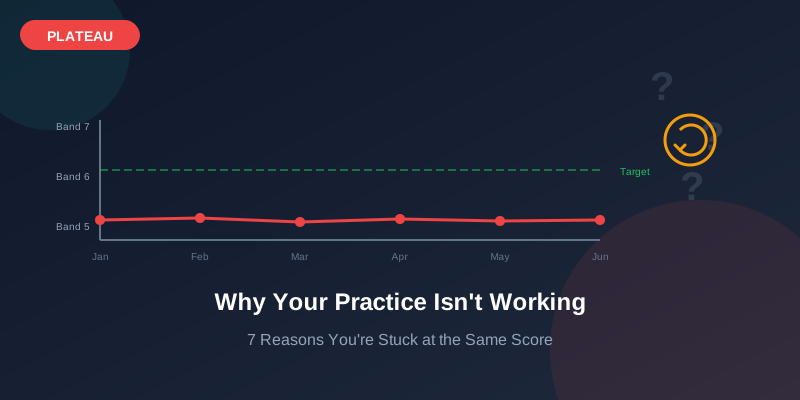
There's nothing more frustrating than putting in hours of work and seeing no results. You've written dozens of practice essays. You've timed yourself. You've checked model answers. Yet every time you take the test—or even a practice test—your score stays stubbornly the same.
If this sounds familiar, you're not alone. Research shows that many IELTS students plateau despite consistent practice. The problem isn't effort; it's approach. Here's why your practice might not be working—and how to fix it.
The Fundamental Problem: Practice Without Feedback
Here's the uncomfortable truth that most students don't hear: writing practice essays without targeted feedback is largely pointless for score improvement.
Think about it. When you write an essay, check the model answer, and move on, what have you actually learned about your own writing? You might notice that the model answer is better, but you probably can't articulate specifically why it scores higher or what you would need to change in your approach.
Research on skill development consistently shows that improvement requires:
- Specific identification of what's wrong
- Understanding of how to fix it
- Deliberate practice of the correction
- Confirmation that the fix worked
Writing essays and reading model answers only gives you step zero—general exposure. It skips the crucial feedback loop that creates actual improvement.
The Seven Reasons Your Practice Isn't Working
1. You Don't Know Your Specific Weaknesses
Many students practice randomly, hoping general improvement will somehow raise their score. But IELTS assesses four distinct criteria, each worth 25%:
- Task Response
- Coherence and Cohesion
- Lexical Resource
- Grammatical Range and Accuracy
If your coherence is strong but your task response is weak, practicing vocabulary won't help. If your grammar is good but you're not answering the question properly, no amount of grammar study will move your score.
The fix: Get a proper diagnostic. Find out exactly which criteria are dragging your score down. Then focus your practice exclusively on those areas until they improve.
2. You're Repeating the Same Mistakes
Without feedback, you practice your errors as much as your strengths. Every time you write "In conclusion, there are both advantages and disadvantages" (a weak conclusion), you reinforce that pattern. Every time you use "moreover" incorrectly, you make the mistake more automatic.
Case study: A student wrote 50+ practice essays over three months. Her Band 5.5 never improved because every essay contained the same article errors, the same weak topic sentences, and the same incomplete task response. She was simply practicing her mistakes 50 times.
The fix: Get feedback that identifies recurring error patterns. Create a checklist of your specific mistakes and review every essay against it before moving on.
3. You're Measuring Practice by Quantity, Not Quality
"I've written 30 essays" sounds impressive but means nothing if those essays weren't analyzed and improved. Five essays with detailed feedback are worth more than 50 essays written into the void.
Research on deliberate practice confirms this: it's not hours logged but quality of focus that drives improvement. Mindless repetition doesn't build skill—targeted, analyzed repetition does.
The fix: Slow down. Write fewer essays but spend more time understanding what worked and what didn't in each one. If possible, revise and rewrite essays after receiving feedback.
4. You're Comparing Yourself to Model Answers (Wrong Approach)
Model answers show you what Band 8+ looks like, but they don't show you how to get there from your current level. The gap between a Band 5 essay and a Band 8 model answer is so large that comparison isn't instructive—it's overwhelming.
What you need isn't examples of perfection. You need examples of essays one level above yours, with clear explanations of what makes them better.
The fix: Instead of comparing to models, compare your current essay to your previous essays. Are you making progress on specific weaknesses? Are your topic sentences clearer this month than last month? Is your coherence improving?
5. You're Not Addressing Task Response
Task Response is the most common cause of stuck scores, yet students frequently overlook it. They focus on grammar and vocabulary—which are easier to identify and fix—while ignoring fundamental issues like:
- Not answering all parts of the question
- Going off-topic
- Having an unclear or inconsistent position
- Not developing ideas fully
You can have perfect grammar and rich vocabulary and still score Band 5 if you haven't actually answered the question.
The fix: Before writing, identify exactly what the question asks. After writing, check explicitly: "Did I address every part of this question? Is my position clear throughout? Did I develop my ideas with specific support?"
6. You're Using Memorized Templates Rigidly
Templates can be helpful training wheels, but rigid template use creates "mechanical" writing that examiners penalize. Phrases like "It is a well-known fact that..." or "In a nutshell..." signal memorization rather than genuine communication.
More problematically, students often force questions to fit their memorized template rather than adapting to what the question actually asks.
The fix: Learn flexible structures, not rigid scripts. Understand why essay structures work so you can adapt them to any question. Practice varying your language rather than using the same phrases repeatedly.
7. You're Not Building General English Proficiency
IELTS Writing tests your English level, not your test preparation level. If your underlying English proficiency is Band 5, no amount of IELTS-specific practice will produce a Band 7 score. Test strategies can't substitute for genuine language ability.
Many students spend months on practice tests when they would benefit more from general English improvement: reading extensively, expanding vocabulary through context, developing sentence variety.
The fix: Combine IELTS practice with broader English development. Read English news daily. Listen to English podcasts. Write journal entries in English. The more English you absorb, the more natural your test writing will become.
What Actually Improves Scores
Research and case studies consistently point to several factors that separate students who improve from those who plateau:
Targeted Feedback on Specific Errors
Students who receive feedback identifying exactly what's wrong—and what specifically to change—improve faster than those who practice independently. The feedback must be specific: "Your topic sentence is vague" is more useful than "Work on coherence."
Focus on High-Impact Weaknesses
Research shows that for Band 5 students, approximately 50-65% of errors cluster in just a few categories—typically articles and coherence. Fixing these high-frequency issues produces disproportionate score improvement.
Deliberate, Analyzed Practice
Rather than writing essay after essay, successful students analyze their work deeply. They identify patterns, create personal error checklists, and monitor improvement on specific issues.
Understanding of Band Descriptors
Students who understand exactly what separates Band 5 from Band 6 can target their practice effectively. Abstract goals like "improve coherence" become concrete: "Every paragraph must have a clear topic sentence that relates to my thesis."
Exposure to Slightly Better Writing
Looking at essays one level above yours—not professional model answers—shows achievable improvement. Understanding the small changes that move an essay from Band 5.5 to Band 6.5 is more actionable than comparing yourself to Band 8+ writing.
The Practice System That Works
If your current practice isn't producing results, try this approach:
Week 1: Diagnosis
- Write one essay under timed conditions
- Get detailed feedback on all four criteria
- Identify your 2-3 most significant weakness patterns
Week 2-3: Targeted Practice
- Focus exclusively on your weaknesses
- Write partial essays (introductions only, body paragraphs only) if needed
- Get feedback on whether you're improving in specific areas
Week 4: Integration
- Write a complete essay under timed conditions
- Compare to your Week 1 essay on specific criteria
- Assess: Am I making the same mistakes, or are new patterns emerging?
Ongoing:
- Maintain a personal error log
- Check every essay against your known weaknesses
- Continue general English exposure through reading and listening
A Reality Check on Improvement Timeline
If you've been stuck at the same score for months, be prepared for improvement to take time. Moving from Band 5 to Band 6 typically requires 2-4 months of focused work—not just more of the same practice, but fundamentally different practice.
The students who improve fastest are those who:
- Stop writing essays randomly and start practicing strategically
- Get honest feedback on their actual weaknesses
- Focus on fixing 2-3 high-impact issues rather than everything at once
- Monitor specific improvements rather than just counting essays completed
The Bottom Line
If your practice isn't working, don't practice more—practice differently. The goal isn't to write more essays; it's to understand what's holding your score back and systematically address those specific issues.
Random practice produces random results. Targeted practice, guided by feedback and focused on your specific weaknesses, produces improvement you can actually measure.
Stop hoping that volume will save you. Start finding out exactly what's wrong, and fix it deliberately.
Ready to find out what's really holding back your score? We're currently in closed beta—join the waitlist to get early access to personalized diagnostic feedback.