
How Long Does It Really Take to Improve One IELTS Band?
Reading time: 13 minutes
When students ask me how long it takes to improve their IELTS score by one band, I understand the urgency behind the question. Immigration deadlines loom. University applications have cutoffs. Career opportunities wait for no one.
The honest answer isn't what most people want to hear: it depends. But that vague response becomes genuinely useful when we break down exactly what it depends on and what research tells us about realistic timelines.
What the Research Says
Two major IELTS research reports provide the most reliable data on improvement timelines:
Finding 1: On average, students taking intensive English courses improve by approximately 0.5 bands in 3 months of study.
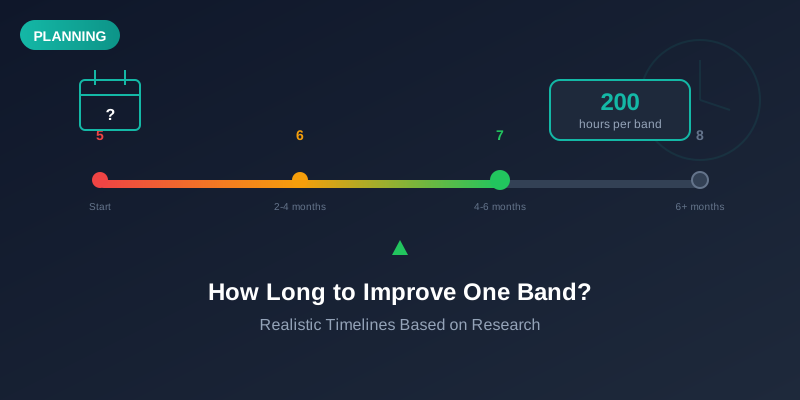
Finding 2: Studies suggest it takes approximately 200 hours of focused study to improve by one full band.
That second finding translates to:
- 5 hours/day for 2 months
- 3 hours/day for about 3 months
- 1-2 hours/day for 4-6 months
However, these are averages. Individual results vary enormously based on several critical factors.
Factors That Speed Up or Slow Down Your Progress
1. Your Starting Level
Counter-intuitively, students at lower levels often improve faster initially. Someone at Band 4 may find it easier to reach Band 5 than someone at Band 6 finds it to reach Band 7. Why?
At lower bands, there are more fundamental issues to fix—basic grammar, elementary vocabulary, clear task response. Addressing these creates significant score jumps. At higher bands, the differences become more subtle. The gap between Band 6 and Band 7 involves nuanced distinctions like "adequate flexibility" versus "skillful flexibility" in vocabulary use.
Typical progression timelines:
- Band 4 to Band 5: 2-3 months intensive study
- Band 5 to Band 6: 2-4 months intensive study
- Band 6 to Band 7: 3-6 months intensive study
- Band 7 to Band 8: 6+ months (often longer)
2. The Skill You're Targeting
Writing and Speaking typically take longer to improve than Reading and Listening. This makes sense: receptive skills (understanding input) develop faster than productive skills (creating output).
If you need Writing improvement specifically—the skill where most students score lowest—expect the process to take longer than overall improvement across all skills.
3. Your Learning Environment and Intensity
A student immersed in an English-speaking country with daily practice opportunities will progress faster than someone studying alone for an hour each evening. Research consistently shows that intensity matters: 20 hours per week produces better results than the equivalent hours spread over longer periods.
4. Whether You're Addressing the Right Weaknesses
This is the factor students most often overlook. Many people repeat the same practice methods expecting different results. If your coherence is poor but you only practice vocabulary, you won't see improvement—no matter how many hours you study.
Case study from research: A student took the IELTS test seven times over two years, scoring Band 5.5 in Writing each time. Despite extensive practice, she never identified her specific weakness patterns. Within one month of receiving targeted feedback that identified her task response issues, she improved to Band 7.
5. Quality of Feedback
Students preparing independently—using only practice tests without expert feedback—often plateau. Research shows that students who receive specific, targeted feedback improve significantly faster than those who self-study without guidance.
The issue isn't motivation or effort; it's that without feedback, you can't see your own errors clearly. You end up practicing your mistakes rather than correcting them.
Realistic Timelines by Starting Level
Based on research data and documented case studies, here's what you can reasonably expect:
Starting at Band 4.0-4.5
Target Band 5.0: 2-3 months
At this level, there are usually fundamental issues with English that require general language improvement, not just test preparation. Focus on building core vocabulary, basic grammar accuracy, and understanding question types.
Target Band 6.0: 4-6 months
This requires more substantial improvement across all criteria. Students should combine general English study with IELTS-specific preparation.
Target Band 7.0: Not realistic in the short term
Jumping from Band 4 to Band 7 typically requires 8-12+ months of dedicated study. It represents moving from "limited" to "good" user status—a significant transformation in English proficiency.
Starting at Band 5.0-5.5
Target Band 6.0: 1-3 months
This is the most common improvement goal, and it's achievable relatively quickly with focused effort. At Band 5, students typically have specific, identifiable weaknesses. Research indicates that 50-65% of Band 5 errors cluster in just two areas: articles and coherence. Targeting these specific issues produces rapid results.
Target Band 7.0: 4-6 months
This requires not just error correction but developing more sophisticated language use. Students need extended vocabulary, complex grammar, and nuanced task response.
Starting at Band 6.0-6.5
Target Band 7.0: 2-4 months
Many students get stuck at this level because the improvements required are more subtle. The difference between Band 6 and Band 7 is often less about "errors" and more about sophistication, flexibility, and precision. Students at this level benefit most from understanding exactly what distinguishes the band levels.
Target Band 8.0: 6+ months
Band 8 requires near-native proficiency and very occasional errors. For most non-native speakers, this takes sustained effort over extended periods.
Why Some Students Improve Faster
Research and case studies reveal clear patterns among fast improvers:
They Get Specific Feedback
Students who understand exactly what's wrong with their writing—and what specifically to change—improve faster than those who simply "practice more." Generic advice like "use more complex sentences" doesn't help; specific feedback like "your topic sentences are vague, here's how to make them clearer" does.
They Focus on High-Impact Errors
Research shows that Band 5 students typically make the same types of errors repeatedly. The 80/20 principle applies: fixing 20% of error types often resolves 80% of the problems dragging down the score. Smart students identify and prioritize these high-impact errors rather than trying to fix everything at once.
They Practice Strategically
Doing 50 practice essays without feedback is less effective than doing 5 essays with detailed analysis of what worked and what didn't. Quality trumps quantity in IELTS preparation.
They Immerse Themselves
Students who read in English daily, listen to English podcasts, and use English in their lives—not just during "study time"—develop language intuition that accelerates improvement.
Warning Signs You're Stuck
If you've been studying for months without score improvement, consider these common causes:
You're practicing without feedback. Writing essays and checking sample answers doesn't reveal your specific weaknesses. You need someone (or something) to analyze your actual writing.
You're focusing on the wrong skill. If your Speaking is Band 7 but your Writing is Band 5, spending equal time on both is inefficient.
You're memorizing rather than learning. Memorizing model essays or vocabulary lists doesn't develop the flexible language use that examiners reward.
You're not addressing task response. Many students focus on grammar and vocabulary while ignoring whether they're actually answering the question correctly.
You're expecting strategies alone to work. Test-taking tips help at the margins, but you can't trick your way from Band 5 to Band 7. Genuine English improvement is required.
The Honest Truth About "Fast" Improvement
Online, you'll find stories of students improving from Band 5 to Band 7 "in two weeks." Take these with skepticism. Usually, such claims involve:
- Students who were already at a higher level but unfamiliar with the test format
- Improvement in one skill, not overall
- Exaggeration or incomplete information
Genuine language improvement takes time. The research is clear: the average student needs months, not weeks, to move up one full band. There's no magic method that bypasses this reality.
That said, you can absolutely be faster than average if you:
- Get accurate diagnosis of your weaknesses
- Receive targeted feedback on your specific errors
- Practice strategically rather than randomly
- Immerse yourself in English as much as possible
Setting Realistic Goals
Rather than asking "How fast can I improve?", ask these questions:
1. What band do I actually need?
Many students aim for Band 7 when their university requires Band 6. Don't chase a higher score than necessary if time is limited.
2. What is my current level honestly?
Take a proper practice test under exam conditions and have it evaluated. Your starting point determines how far you need to travel.
3. How much time can I realistically dedicate?
An hour a day will produce slower results than three hours a day. Be honest about your schedule.
4. Am I addressing my actual weaknesses?
If you don't know specifically what's wrong with your writing, find out before spending months on generic practice.
Timeline Planning
Here's a practical approach to planning your preparation:
Step 1: Take a diagnostic test to establish your current level in each skill.
Step 2: Identify the gap between your current level and your target.
Step 3: Allocate more time to larger gaps and weaker skills.
Step 4: Build in feedback loops—regular assessment of whether you're improving.
Step 5: Adjust your approach if you're not seeing progress within 4-6 weeks.
For Writing specifically, aim to produce and receive feedback on at least one full essay per week. Quality analysis of a smaller number of essays beats rushing through dozens without understanding your errors.
The Bottom Line
Improving one IELTS band typically takes 2-4 months of dedicated study for most students. This timeline can be shortened with intensive effort and expert feedback, or extended if you're practicing without proper guidance.
The students who improve fastest are those who stop asking "How long will this take?" and start asking "What specifically do I need to fix?" Once you know your weaknesses precisely, improvement becomes a matter of targeted work—and that's something you can control.
Not sure what's holding your score back? We're currently in closed beta—join the waitlist to get early access to detailed diagnostic analysis.