
How Personalized Learning Paths Actually Improve IELTS Scores (The Science)
Reading time: 12 minutes
Most IELTS preparation follows a predictable pattern: buy a course, work through every lesson in order, practice past papers, hope for improvement. This approach treats everyone the same regardless of their starting point, native language, or specific weaknesses.
Research shows this standardized approach fails most students. Here's why personalization works better—and what the science actually recommends.
The Problem With Generic Preparation
A comprehensive review of 69 studies on adaptive learning found that personalized approaches improved academic performance in 59% of cases and increased student engagement in 36% of studies. The effect wasn't subtle: students using AI-powered personalization through systems like Squirrel AI showed up to 30% better academic performance.
Yet most IELTS preparation ignores these findings entirely.
Consider the typical Band 5 student. Research on IELTS error patterns reveals that 50-65% of their writing mistakes cluster in just two areas: article errors and coherence problems. But generic courses allocate equal time to vocabulary, grammar, coherence, and task response—spending 75% of study time on areas contributing only 35-50% of their errors.
This is like a doctor prescribing the same treatment to every patient regardless of their symptoms. It's not just inefficient—it often fails entirely.
Why One-Size-Fits-All Fails
Three factors make standardized IELTS preparation particularly ineffective:
Native language interference patterns differ dramatically. A Hindi speaker struggles with articles because Hindi lacks an article system entirely. A Spanish speaker struggles with different article usage patterns. A Chinese speaker faces entirely different challenges with plurals and verb tenses. Generic courses address none of these systematically.
Starting proficiency varies. A student at Band 4.5 needs different intervention than one at Band 5.5, even if both target Band 6. The Band 4.5 student likely has fundamental grammar gaps. The Band 5.5 student probably has adequate grammar but struggles with coherence and vocabulary range. Same destination, completely different paths.
Learning styles and time constraints matter. Some students process visual information faster. Others need audio explanation. Some have 20 minutes daily; others have 2-hour blocks twice weekly. Effective learning adapts to these realities.
What Research Says About Effective Personalization
A 2024 scoping review identified what makes adaptive learning actually work:
Diagnostic assessment first. The most effective systems use pre-knowledge quizzes to determine exactly where each student stands before suggesting content. This was the most common trigger for activating adaptive content delivery across all successful implementations.
Targeted intervention on highest-impact areas. Research consistently shows focused feedback on 2-3 specific error types produces superior results compared to comprehensive correction of all errors. Students cognitively process limited feedback more effectively, with studies indicating maximum absorption of about 3 improvement areas per learning cycle.
Immediate feedback loops. Learning science demonstrates feedback must arrive within 24-48 hours for optimal impact. Delayed feedback allows errors to become reinforced habits. Personalized systems provide this immediacy.
Difficulty calibration. Studies using adaptive text selection found high school learners who received content matched to their current level achieved greater learning gains compared to students receiving standardized difficulty. Too easy means no challenge; too hard means cognitive overload. The sweet spot is personalized.
The 80/20 of IELTS Writing Improvement
Here's what diagnostic data from thousands of Band 5 essays reveals:
The two biggest score killers:
- Article errors (overuse, omission, wrong choice)
- Coherence breakdowns (unclear progression, mechanical linking)
What generic courses over-emphasize:
- Vocabulary synonyms (important, but lower impact than fixing grammar patterns)
- Essay templates (helpful, but don't address underlying skill gaps)
- Practice test volume (ineffective without targeted feedback)
What actually moves scores:
- Identifying your specific high-frequency error patterns
- Deliberate practice on those patterns until automaticity
- Progressive complexity once basics are mastered
A student who fixes their article usage and develops genuine paragraph coherence will improve more than one who memorizes 500 new vocabulary words but keeps making the same structural mistakes.
How Adaptive Learning Systems Work
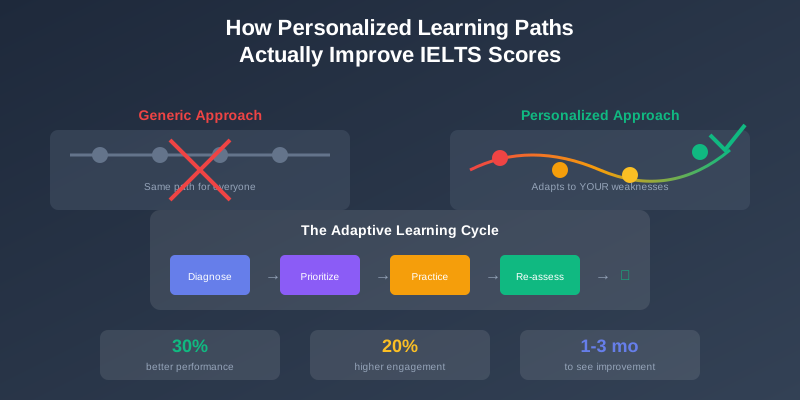
The most effective personalized approaches follow a specific cycle:
Step 1: Diagnostic Assessment
The system analyzes your writing to identify specific weakness patterns. Not just "grammar needs work" but "missing articles before singular countable nouns in 73% of cases" and "topic sentences absent in body paragraphs."
Step 2: Prioritized Learning Path
Based on your diagnosis, the system recommends specific modules addressing your highest-impact weaknesses first. This might mean: Week 1-2 focus on article rules for countable nouns; Week 3-4 focus on paragraph structure with topic sentences.
Step 3: Targeted Practice
You complete exercises designed specifically for your identified weaknesses. Not random grammar exercises—but article exercises involving the exact error patterns you demonstrated.
Step 4: Re-assessment and Adjustment
After targeted practice, you submit new writing. The system re-analyzes to measure improvement and identify what to work on next. Maybe articles are now 85% accurate, so the focus shifts to verb tense consistency.
Step 5: Iteration Until Graduation
This cycle repeats until you consistently demonstrate Band 6 (or your target) performance across all criteria. The path adapts based on your progress—accelerating through areas where you improve quickly, spending more time where you struggle.
The Evidence for Diagnostic-First Approaches
Studies of intelligent tutoring systems consistently show they can match the effectiveness of one-on-one human tutoring—what researchers call the "two-sigma effect" (two standard deviations of improvement over traditional instruction).
A meta-analysis found ITS systems for physics achieved the same effect size as human tutors. The AI-powered platform Korbit showed 2.5 times higher scores compared to non-adaptive courses.
Why does personalization work so well? The research points to several mechanisms:
Reduced cognitive load. When content matches your current level, you're not overwhelmed by material too advanced for your knowledge base. Learning happens in your "zone of proximal development."
Higher engagement. Students in personalized systems show 20% higher engagement rates. When content feels relevant to your specific struggles, motivation increases.
Faster feedback cycles. Adaptive systems enable multiple practice-feedback loops in single sessions. Traditional courses might provide feedback once per week; personalized systems provide it continuously.
Addressing the real bottleneck. Most students have 2-3 critical weaknesses preventing improvement. Personalization identifies and eliminates these bottlenecks directly instead of hoping broad coverage eventually addresses them.
Why Generic Feedback Fails
Traditional IELTS feedback typically sounds like: "Your coherence needs work. Try to use more linking words."
This fails for specific reasons:
Too vague to act on. "Coherence needs work" doesn't tell you what to do differently. Which sentences lacked connection? What linking words are appropriate where?
May be wrong priority. If your coherence is at Band 5.5 but your grammar is at Band 4, improving coherence won't help much—grammar is the bottleneck.
No progression pathway. Even if you improve your linking words, what's next? Generic feedback doesn't sequence your learning.
Ignores your L1 patterns. A Hindi speaker's coherence problems may stem from different discourse conventions than a Mandarin speaker's. Generic feedback ignores these patterns.
Research shows students who receive focused feedback on 2-3 specific areas outperform those receiving comprehensive correction of all errors. Your brain can only process and implement limited changes at once.
What Personalized IELTS Preparation Looks Like
Here's the contrast:
Generic approach:
- Week 1: Introduction to IELTS Writing
- Week 2: Essay structure overview
- Week 3: Vocabulary building
- Week 4: Grammar review
- Week 5: Practice test 1
- Week 6: Practice test 2
- (Same path for every student)
Personalized approach:
- Day 1: Diagnostic assessment identifies article omission (45% of grammar errors) and missing topic sentences (primary coherence issue) as your biggest weaknesses
- Week 1-2: Focused module on article usage with Hindi-speaker specific patterns, immediate practice with AI feedback
- Week 3-4: Topic sentence and paragraph structure module, practice essays focusing specifically on opening sentences
- Week 5: Re-assessment shows article accuracy improved to 82%, topic sentences now present—but verb tense issues emerging
- Week 6+: Focus shifts to verb tense consistency
- (Path adapts based on your progress)
The personalized student spends their study time on exactly what will improve their score. The generic student hopes the standardized curriculum eventually addresses their specific gaps.
Making Personalization Work for You
Even without specialized software, you can apply personalization principles:
Get diagnostic feedback first. Before buying any course, get your current writing assessed specifically for error patterns. Know whether you're losing marks primarily on grammar, coherence, vocabulary, or task response.
Focus on your top 2-3 weaknesses. Resist the urge to "work on everything." Pick your highest-impact improvement areas and prioritize them.
Track specific patterns, not just scores. Don't just record "Band 5.5"—note "articles: 7 errors, verb tense: 3 errors, unclear pronouns: 2 errors." This lets you measure actual improvement.
Match content to your current level. If you're at Band 5, studying Band 8 model essays won't help much. Find resources appropriate to your next achievable level.
Consider your native language. Research indicates L1 interference causes systematic error patterns. Seek resources addressing your specific language background.
The Time Factor
Research on skill acquisition suggests 20-30 analyzed essays with targeted feedback matter more than 100 practice essays without guidance. Quality of practice trumps quantity.
Personalized approaches leverage this by ensuring each practice essay builds on previous feedback. Instead of repeating the same mistakes across 50 essays, you deliberately eliminate specific errors and demonstrate new competencies.
Students using diagnostic-first approaches typically see measurable improvement in 1-3 months rather than the 6-12 months often required with generic preparation. The efficiency gain comes from working on the right things from the start.
The Bottom Line
Generic IELTS preparation treats every student identically despite evidence that this approach works for fewer than half of learners. Personalized, diagnostic-first approaches align with decades of educational research showing adaptive learning consistently outperforms one-size-fits-all instruction.
The science is clear: identify your specific weaknesses, focus on highest-impact areas first, get immediate targeted feedback, and iterate. This approach is how students break through plateaus that generic preparation never resolves.
Ready to discover exactly what's limiting your IELTS Writing score? We're currently in closed beta—join the waitlist to get early access to personalized diagnostic assessment and learning paths.