
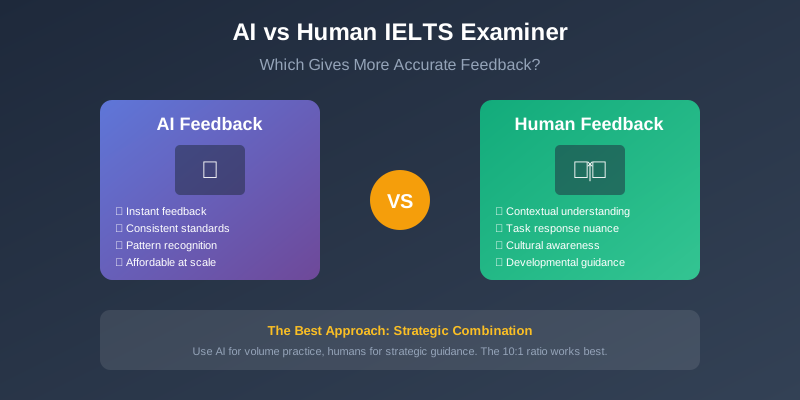
AI vs Human IELTS Examiner: Which Gives More Accurate Feedback?
Reading time: 11 minutes
If you're preparing for IELTS Writing, you've probably wondered whether AI tools can truly replace human feedback. With dozens of AI-powered IELTS assessment platforms now available, this question matters more than ever for your preparation strategy and budget.
The honest answer? Neither is universally better. Each has distinct advantages that matter at different stages of your preparation journey.
What the Research Actually Shows
A 2024 study published in Learning and Instruction compared ChatGPT's feedback against 16 expert human evaluators on 200 student essays. On a five-point quality scale, humans averaged 4.0 while AI averaged 3.6. The gap was closest on criteria-based feedback (matching writing to rubrics) and widest on developmental appropriateness—knowing what advice suits a student's current level.
Another study examining IELTS-specific AI tools found that specialized platforms like UpScore.ai achieved mean absolute errors of just 0.5 bands compared to human examiners, while general tools like ChatGPT showed errors of 0.9 bands. The difference? Purpose-built training on IELTS band descriptors.
Here's what these numbers mean practically: AI tools trained specifically on IELTS criteria can predict your band score within about half a band most of the time. Human examiners themselves only agree exactly about 50% of the time, with official IELTS inter-rater reliability coefficients of 0.90-0.92. Neither system is perfect.
Where AI Feedback Excels
Speed and availability. AI delivers feedback in seconds, not days. Research shows feedback must arrive within 24-48 hours for optimal learning impact. Waiting a week for human feedback means you've already forgotten why you made specific choices.
Consistency. AI applies identical standards to every essay. It won't have a bad day, get fatigued after marking 50 essays, or unconsciously favor certain writing styles. One study found human raters' accuracy declined measurably during marathon grading sessions.
Grammar and mechanics. AI excels at catching surface errors: subject-verb agreement, article usage, spelling mistakes. These constitute a significant portion of Band 5 errors, making AI particularly valuable for students at this level.
Cost and accessibility. Quality human feedback costs $4-30+ per essay. AI tools range from free to $15-50 monthly for unlimited submissions. For students in emerging markets, this difference determines whether they can afford regular practice feedback at all.
Pattern recognition at scale. AI can analyze thousands of essays to identify common error patterns. It might recognize that you consistently misuse articles before countable nouns—a pattern a human might not track systematically across multiple essays.
Where Human Feedback Wins
Contextual understanding. An AI tool in one documented case awarded Band 8.5 to an off-topic essay written partially in Hindi script. Humans immediately recognize when something is fundamentally wrong with a response, even if individual sentences are grammatically correct.
Task Response nuance. This criterion requires understanding whether arguments are relevant, logically developed, and appropriately positioned. Research consistently shows AI struggles most with evaluating higher-order concerns: Does this argument actually support your thesis? Is this example relevant to this specific question?
Developmental appropriateness. The 2024 study found human evaluators' biggest advantage was knowing what advice suits a student's current level. Telling a Band 5 writer to use more sophisticated hedging language isn't helpful—they need to master basic coherence first.
Cultural and idiomatic awareness. AI trained primarily on Western English corpora may mark perfectly acceptable Indian English expressions as errors. Human examiners are trained to recognize legitimate regional variations.
Motivation and rapport. Students often ignore feedback from machines. The same study noted that human feedback, delivered with supportive tone and relationship context, leads to higher implementation rates.
The Accuracy Question by Band Level
Research reveals an important pattern: AI accuracy varies significantly by essay quality.
For Band 5-6 essays, AI tools perform nearly as well as humans. These essays typically contain systematic errors that AI catches effectively: grammar mistakes, basic vocabulary repetition, mechanical coherence problems.
For Band 7+ essays, human evaluation becomes increasingly important. At higher levels, the differences between scores involve subtle distinctions—flexibility of vocabulary use, sophistication of argument structure, naturalness of cohesion. These nuances challenge even the best AI systems.
This has direct implications for your preparation strategy. If you're currently at Band 5 and targeting Band 6, AI feedback may be sufficient for most of your practice. If you're at Band 6.5 targeting Band 7+, investing in periodic human evaluation becomes more valuable.
Real-World Accuracy Comparison
Here's how different feedback sources typically perform:
| Feedback Source | Accuracy vs Human Examiner | Best For |
|---|---|---|
| Generic ChatGPT | 0.9 band variance | Quick grammar checks |
| IELTS-trained AI | 0.5 band variance | Regular practice feedback |
| Human tutor | Variable (depends on training) | Strategic guidance |
| Former IELTS examiner | Highest accuracy | Pre-test assessment |
The caveat: "Human tutor" varies enormously. A general English teacher without IELTS examiner training may actually be less accurate than purpose-built AI. Former IELTS examiners represent the gold standard, but their feedback typically costs $30-100+ per session.
What AI Gets Wrong
Understanding AI limitations helps you use it more effectively:
Topic relevance blindness. Most AI tools evaluate language quality without reliably assessing whether you've actually answered the question. You might receive feedback praising your grammar on an essay that completely misunderstands the prompt.
Overconfidence on complex assessment. AI often sounds authoritative when evaluating argumentation and coherence, but research shows these assessments are less reliable than its grammar feedback.
Formulaic feedback patterns. One researcher noted AI feedback became "so formulaic and conservative" that it gave similar suggestions regardless of essay quality—asking for more examples in papers that already had plenty.
Cultural bias. AI trained predominantly on native speaker corpora may penalize legitimate non-native English patterns. This particularly affects students from specific linguistic backgrounds.
The Best Approach: Strategic Combination
Research increasingly points toward blended approaches. A study of language learners found no difference in learning outcomes between AI-only and human-only feedback groups—but students expressed strong preference for receiving both.
Here's a practical framework:
Use AI for:
- Daily or weekly practice essays (volume matters for improvement)
- Immediate grammar and spelling corrections
- Tracking error patterns across multiple essays
- Identifying which criteria need the most work
- Building habits of seeking feedback
Use human feedback for:
- Pre-test assessments (get an accurate baseline)
- Strategic guidance on what to prioritize
- Evaluating whether your arguments actually work
- Understanding band descriptor requirements at your target level
- Motivation and accountability
The 10:1 ratio: Consider roughly 10 AI-assessed practice essays for every 1 human-evaluated essay. This gives you the volume needed for improvement while ensuring periodic calibration with human judgment.
Choosing Your AI Tool
Not all AI feedback is equal. When evaluating options:
Check for IELTS-specific training. Generic grammar checkers won't give you band-score-relevant feedback. Look for tools explicitly trained on IELTS band descriptors.
Evaluate criterion coverage. Does the tool assess all four criteria (Task Response, Coherence and Cohesion, Lexical Resource, Grammar)? Some only address grammar.
Test with known samples. Submit the same essay to multiple tools and compare feedback. Significant disagreements suggest lower reliability.
Look for learning pathways. Assessment alone doesn't improve scores. The most effective tools diagnose weaknesses and provide targeted practice, not just scores.
The Bottom Line
Neither AI nor human feedback is inherently superior. The question isn't which is "better"—it's which serves your specific needs at your current stage.
If you're a Band 5 student needing volume and immediate feedback on grammar errors, AI tools offer excellent value. If you're a Band 6.5 student struggling to understand why your arguments aren't quite reaching Band 7, human insight becomes more valuable.
The most successful IELTS candidates treat AI as their practice partner and humans as their strategic advisors. This combination delivers both the repetition needed for skill building and the judgment needed for breakthrough improvements.
Struggling to improve your IELTS Writing score? We're currently in closed beta—join the waitlist to get early access to AI-powered diagnosis and personalized learning paths.