
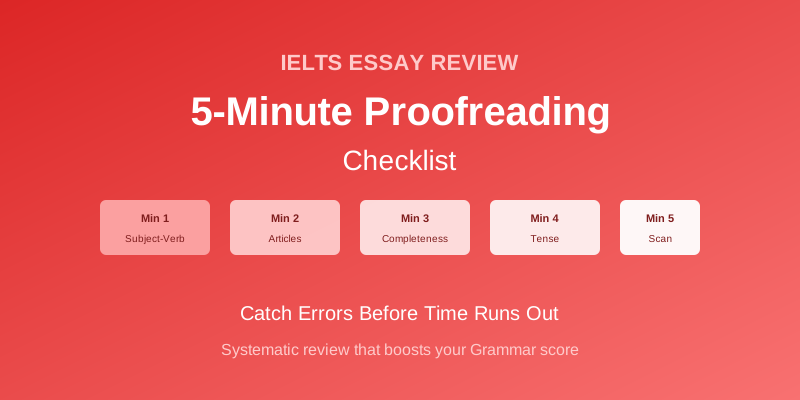
The 5-Minute IELTS Essay Proofreading Checklist
Those final 5 minutes of your IELTS Writing test are more valuable than most students realize. A quick, focused proofread can catch errors that cost you marks in Grammatical Range and Accuracy—errors you already know how to fix but made in the rush of writing.
This checklist gives you a systematic 5-minute review that targets the highest-impact errors.
Why Proofreading Matters for Your Score
The band descriptors for Grammar distinguish between:
- Band 5: "May make frequent grammatical errors and punctuation may be faulty"
- Band 6: "Makes some errors in grammar and punctuation but they rarely reduce communication"
- Band 7: "Produces frequent error-free sentences; has good control of grammar and punctuation"
Those "frequent error-free sentences" at Band 7 can partly come from catching and fixing errors during proofreading.
The 5-Minute System
Divide your 5 minutes into focused passes. Each pass looks for specific error types.
Minute 1: Subject-Verb Agreement
Check for:
- Singular subjects with plural verbs (or vice versa)
- Complex subjects that are actually singular
- "There is" vs "There are" usage
Common errors to catch:
- "The number of students are increasing" → "is increasing"
- "Technology have changed" → "has changed"
- "There is many reasons" → "There are many reasons"
Minute 2: Articles (The/A/An)
Check for:
- Singular countable nouns without articles
- General concepts with "the" that shouldn't have it
- Missing "the" for specific references
Common errors to catch:
- "He is doctor" → "He is a doctor"
- "The education is important" → "Education is important"
- "Government should invest" → "The government should invest"
Minute 3: Sentence Completeness
Check for:
- Sentence fragments (incomplete sentences)
- Run-on sentences
- Missing subjects (especially "it" and "there")
Common errors to catch:
- "Is important to study." → "It is important to study."
- "Many people agree they support this." → Add period or connector
- "Because technology is helpful." → Combine with previous sentence
Minute 4: Tense Consistency
Check for:
- Switching tenses within paragraphs without reason
- Past tense when discussing general truths
Common errors to catch:
- "Technology changes lives. It made communication easier." → "makes"
- "Last year, the government introduce policies." → "introduced"
Minute 5: Quick Final Scan
Spelling of common words:
- government, environment, definitely, because, which
Punctuation basics:
- Capital letter at sentence starts
- Period at sentence ends
- Word count over 250
Printable Checklist
Minute 1: Subject-Verb Agreement
- Every verb matches its subject?
- "The number of..." takes singular verb?
- "There is" vs "There are" correct?
Minute 2: Articles
- Singular countable nouns have articles?
- General concepts without "the"?
- Specific references with "the"?
Minute 3: Complete Sentences
- Every sentence has subject AND verb?
- No run-on sentences?
- No fragments?
Minute 4: Tense Consistency
- Same tense throughout each paragraph?
- General truths in present tense?
Minute 5: Final Scan
- Spelling correct?
- Capitals and periods?
- Over 250 words?
My Personal Errors:
What NOT to Do
Don't restructure—it's too late for major changes
Don't second-guess correct sentences—only fix confident errors
Don't read for meaning—your brain will skip over errors
Key Takeaways
- Reserve 5 minutes—worth more than extra writing
- Use focused passes—one error type at a time
- Know your patterns—customize for your common errors
- Practice the skill—proofreading improves with practice
Want help identifying your error patterns? BandWriteCoach analyzes your essays and shows you which errors you make most often.