
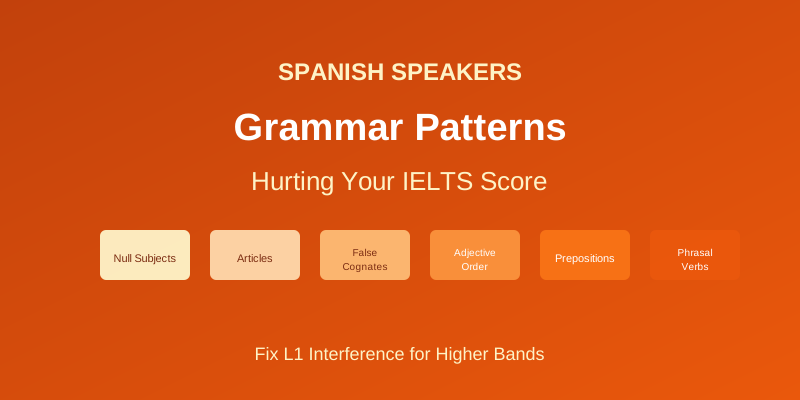
Spanish Speakers: Grammar Patterns Hurting Your IELTS Score
Spanish speakers have an advantage in IELTS preparation: English and Spanish share Latin roots, grammatical similarities, and many cognates. However, these similarities can also create false confidence—and systematic errors that cost you marks.
Research on Spanish-speaking IELTS candidates shows that approximately 76% think in Spanish first and then translate their ideas into English. This mental translation creates predictable error patterns that appear consistently in essays from Spanish speakers worldwide, from Spain to Mexico to Argentina.
Understanding these patterns isn't just helpful—it's essential for improving your Grammatical Range and Accuracy score. Let's examine the most common errors and how to fix them.
Why Spanish Speakers Face Specific IELTS Challenges
Spanish and English are both Indo-European languages, so they share more structural similarities than, say, English and Chinese. This similarity helps with vocabulary and basic comprehension, but it creates a trap: you assume the languages work the same way, so you don't notice when they don't.
Researchers call this "negative transfer"—when patterns from your first language interfere with your second language. Studies show that Spanish speakers make more errors precisely where they feel Spanish and English are similar: articles, prepositions, and word order.
The good news: these are consistent patterns, not random mistakes. Once you identify them, you can systematically eliminate them.
Error 1: Subject Omission (Null Subjects)
This is one of the most common errors for Spanish speakers in IELTS Writing.
Why This Happens
Spanish is a "null subject" language—you can omit the subject pronoun because the verb ending indicates who's acting. "Hablo español" means "I speak Spanish"—the "yo" (I) is optional because "hablo" already tells you it's first person singular.
English requires explicit subjects in almost every sentence. When you translate from Spanish thinking, you often omit subjects that are mandatory in English.
Common Patterns
Missing "it" as subject:
- ❌ "Is important to study every day."
- ✓ "It is important to study every day."
Missing "there" in existential sentences:
- ❌ "Are many reasons for this problem."
- ✓ "There are many reasons for this problem."
Missing subject pronouns:
- ❌ "The teacher explained the lesson and gave homework."
- ✓ "The teacher explained the lesson and gave homework." (This one is fine—same subject)
- ❌ "The policy was introduced in 2020. Was not popular."
- ✓ "The policy was introduced in 2020. It was not popular."
How to Fix It
Every English sentence needs an explicit subject. Special attention:
- Sentences starting with "is/are" usually need "It" or "There" in front
- After a period, check: does the new sentence have its own subject?
Test: Can you identify WHO or WHAT is doing the action? If not, add the subject.
Error 2: Article Errors (The/A/An)
Surprisingly, Spanish speakers make significant article errors even though Spanish has articles. The problem is that the languages use them differently.
Why This Happens
Spanish uses the definite article ("el/la") in many contexts where English uses no article. "La vida es difícil" uses "la" (the), but in English we say "Life is difficult" without any article.
Additionally, Spanish doesn't use articles before professions or nationalities in the same way English does.
Common Patterns
Adding "the" before general concepts:
- ❌ "The life is hard for the students."
- ✓ "Life is hard for students."
Missing article before professions:
- ❌ "My sister is hairdresser."
- ✓ "My sister is a hairdresser."
Using "the" instead of possessives:
- ❌ "She broke the arm." (Spanish uses "el brazo")
- ✓ "She broke her arm."
How to Fix It
Rules for Spanish speakers:
- General concepts (life, education, society, love) = NO article
- Singular countable nouns need an article or determiner
- Professions always need "a/an": "She is a doctor"
- Body parts use possessives in English, not "the"
Error 3: False Cognates (False Friends)
Spanish and English share many cognates (similar words with similar meanings), but some are "false friends"—they look similar but mean different things.
Why This Happens
When you see a word that looks like a Spanish word, your brain assumes it means the same thing. Sometimes it does; sometimes it doesn't.
Common Patterns
Actual vs. Actually:
- ❌ "The actual price is very high." (meaning "current")
- ✓ "The current price is very high."
- Note: "Actual" in English means "real," not "current"
Assist vs. Attend:
- ❌ "I assisted the meeting yesterday." (from "asistir")
- ✓ "I attended the meeting yesterday."
- Note: "Assist" means "help," not "be present at"
Sensible vs. Sensitive:
- ❌ "She is very sensible and cries easily." (from "sensible")
- ✓ "She is very sensitive and cries easily."
- Note: "Sensible" in English means "practical/reasonable"
Embarrassed vs. Pregnant:
- ❌ "She is embarrassed." (from "embarazada" meaning pregnant)
- ✓ "She is pregnant."
- Note: "Embarrassed" means feeling ashamed/uncomfortable
How to Fix It
Learn common false cognates and their correct English equivalents:
- actualmente → currently (not actually)
- asistir → attend (not assist)
- sensible → sensitive (not sensible)
- realizar → achieve/carry out (not realize, usually)
- pretender → intend (not pretend)
Keep a list and review it regularly.
Error 4: Adjective Placement
Spanish adjective rules differ from English, causing word order errors.
Why This Happens
In Spanish, most adjectives come AFTER the noun: "casa blanca" (house white). In English, adjectives come BEFORE the noun: "white house."
Also, Spanish uses adjectives where English uses adverbs with verbs.
Common Patterns
Adjective after noun:
- ❌ "The problem environmental is serious."
- ✓ "The environmental problem is serious."
Multiple adjectives in wrong order:
- ❌ "A round, big, red ball"
- ✓ "A big, round, red ball"
- (English has a specific order: size → shape → color)
How to Fix It
In English: Adjectives come BEFORE nouns
- "important decisions" not "decisions important"
- "young people" not "people young"
- "economic problems" not "problems economic"
Error 5: Preposition Errors
Prepositions are difficult for all language learners, but Spanish speakers make specific, predictable errors.
Why This Happens
Spanish prepositions don't map one-to-one with English prepositions. "En" can mean "in," "on," or "at." "Para" can mean "for" or "to." When you translate mentally, you often choose the wrong English preposition.
Common Patterns
"In" instead of "at/on":
- ❌ "She is good in tennis." (from "buena en tenis")
- ✓ "She is good at tennis."
"In" instead of "on" for surfaces:
- ❌ "The book is in the table."
- ✓ "The book is on the table."
"Of" instead of "from":
- ❌ "She is of Spain."
- ✓ "She is from Spain."
"For + infinitive" instead of "to + infinitive":
- ❌ "I study for pass the exam." (from "para aprobar")
- ✓ "I study to pass the exam."
How to Fix It
Learn verb + preposition combinations as fixed phrases:
- good AT (not in)
- depend ON (not of)
- interested IN (not for)
- consist OF (not in)
- different FROM (not of)
Don't translate prepositions word-for-word from Spanish.
Error 6: Phrasal Verb Omission
Spanish speakers often leave out the preposition parts of phrasal verbs.
Why This Happens
Spanish uses single verbs where English uses verb + preposition combinations. "Romper" = "break" but also "break down," "break up," "break out," etc. When you translate from Spanish, you often omit the preposition part.
Common Patterns
Missing preposition:
- ❌ "My car broke." (when meaning stopped working)
- ✓ "My car broke down."
Wrong or missing particle:
- ❌ "I am looking forward to see you."
- ✓ "I am looking forward to seeing you."
Missing "up/out/down":
- ❌ "The building burned completely."
- ✓ "The building burned down."
How to Fix It
Learn common phrasal verbs:
- break down (stop working)
- give up (quit)
- look after (care for)
- find out (discover)
- carry out (complete/execute)
Error 7: Pronoun Gender Confusion
Spanish has grammatical gender that doesn't exist the same way in English.
Why This Happens
In Spanish, "su" can mean "his," "her," "its," "your," or "their." When you translate, you sometimes choose the wrong English pronoun. Additionally, Spanish assigns gender to objects, which English doesn't do.
Common Patterns
Wrong possessive pronoun:
- ❌ "Mary said that his car was broken." (from "su coche")
- ✓ "Mary said that her car was broken."
Wrong object pronoun:
- ❌ "The policy was introduced. The government promoted him."
- ✓ "The policy was introduced. The government promoted it."
How to Fix It
In English:
- People: he/him/his (male), she/her/hers (female)
- Things: it/its
- Always check: what is the pronoun referring to? Match the pronoun to that referent.
Action Plan for Spanish Speakers
Week 1-2: Subject and Article Focus
- Check every sentence for an explicit subject
- Practice "It is..." and "There are..." structures
- Focus on when NOT to use "the" in English
Week 3-4: False Friends and Prepositions
- Review false cognate list daily
- Learn 10 new verb + preposition combinations
- Practice without translating from Spanish
Week 5-6: Word Order and Phrasal Verbs
- Ensure adjectives come before nouns
- Learn common phrasal verbs
- Write essays and check for these specific patterns
How AI Feedback Helps Spanish Speakers
Standard IELTS feedback marks errors without identifying L1 patterns. If you keep writing "is important" without "it," generic feedback just corrects the sentence without explaining why you make this error consistently.
AI tools like BandWriteCoach can recognize Spanish-specific interference patterns, providing feedback that:
- Connects your errors to Spanish grammar rules
- Identifies false cognates you're misusing
- Flags preposition patterns that differ between languages
- Helps you build English-specific habits
This targeted approach helps you understand WHY you make certain errors, not just THAT you made them.
Key Takeaways
- English always needs a subject—don't omit "it" or "there"
- General concepts don't use "the"—unlike Spanish
- Beware false cognates—actually ≠ actualmente
- Adjectives come BEFORE nouns—reverse your Spanish order
- Learn prepositions as phrases—don't translate from Spanish
- Phrasal verbs need their particles—"break down," not just "break"
- Match pronouns to their referents—"she" for women, "it" for things
These patterns explain most grammar errors in Spanish speakers' IELTS essays. Address them systematically to improve your Grammatical Range and Accuracy score.
Ready to identify Spanish-specific patterns in your writing? BandWriteCoach provides AI feedback that recognizes L1 interference and helps you build stronger English writing habits.