
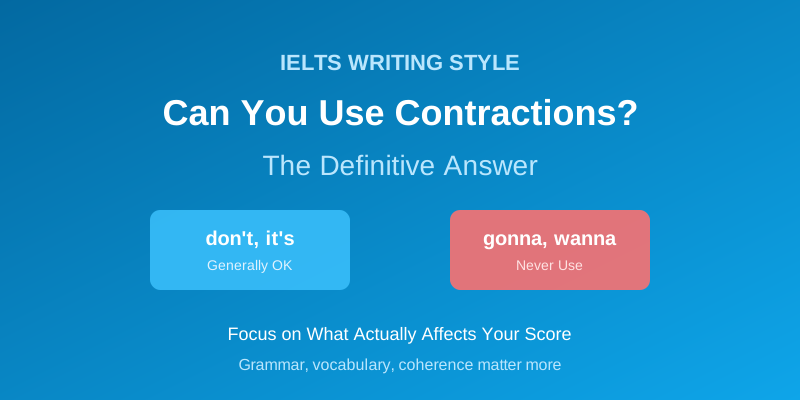
Can You Use Contractions in IELTS Writing? The Definitive Answer
"Don't use contractions in IELTS Writing!" is common advice. But is it actually true? And how much would using contractions really affect your score?
This guide gives you the definitive answer—backed by what the band descriptors actually say, what examiners actually look for, and practical guidance for your test.
The Short Answer
Contractions won't automatically cost you marks in IELTS Writing.
IELTS doesn't explicitly prohibit contractions. The band descriptors say nothing about contractions. Examiners assess your grammar, vocabulary, coherence, and task response—not whether you wrote "don't" instead of "do not."
However, the longer answer involves understanding tone, context, and risk management.
What IELTS Actually Says
The IELTS band descriptors for Grammatical Range and Accuracy assess:
- Range of structures
- Accuracy of structures
- Control of grammar and punctuation
- Whether errors reduce communication
Notice what's NOT mentioned: contractions, formal/informal style, or specific forbidden words.
The Lexical Resource descriptors mention "awareness of style and collocation." This is where tone becomes relevant—but it's not about contractions specifically.
The Real Question: Tone and Register
IELTS Writing Task 2 expects an academic or semi-formal tone. This means:
- No slang
- No text-speak (u, r, lol)
- No overly casual expressions
- Organized, reasoned arguments
Contractions exist in a gray area. They're common in spoken English and informal writing but less common in academic papers. Here's where it gets nuanced:
Full Academic Writing
In university essays and published research, contractions are typically avoided. "It is" is preferred over "It's."
IELTS Writing
IELTS is testing your English ability, not your knowledge of academic conventions. It's closer to a proficiency test than a university assignment.
Native Speakers
Native English speakers regularly use contractions in professional contexts—business emails, journalism, even some academic writing. It's not considered incorrect.
The Expert Disagreement
IELTS teachers and examiners disagree on this issue:
Conservative view:
"Avoid contractions. Academic writing should be formal. Why take the risk?"
Progressive view:
"Contractions are natural English. Using them shows fluency. IELTS doesn't penalize them."
Practical view:
"Contractions don't matter much either way. Focus on what actually affects your score."
What Contractions Are We Talking About?
Not all contractions are equal:
Standard Contractions (Common in English)
- I'm, you're, we're, they're
- don't, doesn't, can't, won't, isn't, aren't
- I've, you've, we've, they've
- it's, that's, there's
These are used by educated native speakers across contexts.
Informal Contractions (Avoid in IELTS)
- gonna (going to)
- wanna (want to)
- gotta (got to)
- ain't (isn't/aren't)
- dunno (don't know)
These are spoken forms that should NEVER appear in IELTS Writing.
The Key Distinction
"Don't" in an essay = probably fine
"Gonna" in an essay = definitely problematic
Practical Guidance by Task
Academic Task 1 (Reports)
Recommendation: Avoid contractions
Task 1 reports describe data objectively. They're closer to technical writing, where contractions are less common.
Example:
- "The graph shows that the rate does not increase significantly."
- "The graph shows that the rate doesn't increase significantly."
Both are grammatically correct, but the first sounds more appropriate for a data report.
Task 2 (Essays)
Recommendation: Either is acceptable, but consistency matters
Task 2 essays are argumentative writing. Some contractions can sound natural. However, if you're unsure, avoid them.
Example:
- "I believe that governments should not ignore this issue."
- "I believe that governments shouldn't ignore this issue."
Both are acceptable. The first is more formal; the second is more conversational.
General Training Task 1 (Letters)
Depends on letter type:
- Formal letters (to employers, officials, companies): Avoid contractions
- Semi-formal letters (to landlords, colleagues you don't know well): Occasional contractions acceptable
- Informal letters (to friends): Contractions are expected and natural
What Actually Costs You Marks
Instead of worrying about contractions, focus on these actual problems:
Grammar Errors That Matter
- Subject-verb agreement: "The data shows" (not "The data show" in IELTS context)
- Articles: "The government should invest in the education" (incorrect)
- Tense consistency: Mixing past and present without reason
- Sentence fragments: "Because technology is important."
- Run-on sentences: Two sentences without proper punctuation
Vocabulary Issues That Matter
- Wrong word choice: "Technology makes many advantages" (gives, provides)
- Incorrect collocations: "Do a decision" (make a decision)
- Repetition: Using the same word repeatedly
- Inappropriate register: "Loads of people think..." (Many people believe...)
Coherence Problems That Matter
- Missing or illogical paragraphing
- Over-use of linking words: "Firstly... Secondly... Furthermore... Moreover..."
- Ideas that don't connect
- Missing thesis or conclusion
Contractions are minor compared to these issues.
The Risk Assessment Approach
Think about this pragmatically:
If you use contractions:
- Worst case: Examiner notes slightly informal tone (minimal impact)
- Best case: Essays sound natural and fluent
If you avoid contractions:
- Worst case: Slightly more formal than necessary (no negative impact)
- Best case: Clearly academic tone
Conclusion: Avoiding contractions has no downside. Using them has a very small potential downside. For risk-averse test-takers, simply avoid them.
My Recommendation
For students aiming for Band 6-6.5:
Don't worry about contractions. Focus on more important issues like grammar accuracy, task response, and coherence. Using contractions won't hurt you.
For students aiming for Band 7+:
Consider avoiding contractions, not because they're wrong, but because:
- Academic tone slightly helps Lexical Resource score
- It's one less thing to think about
- High-scoring essays tend to be more formal anyway
For all students:
NEVER use informal contractions like "gonna," "wanna," or "gotta."
Quick Reference
| Contraction Type | Task 1 Academic | Task 2 | Formal Letter | Informal Letter |
|---|---|---|---|---|
| Standard (don't, it's) | Avoid | Acceptable | Avoid | Use |
| Informal (gonna, wanna) | Never | Never | Never | Acceptable |
The Bottom Line
Contractions are not forbidden in IELTS Writing. Using standard contractions like "don't" or "it's" won't significantly impact your score. However, since there's no advantage to using them and a small potential to appear slightly informal, you might as well avoid them if you remember.
But don't stress about this. If you accidentally write "don't" instead of "do not," it won't change your band score. Your grammar, vocabulary, coherence, and task response matter far more.
Key Takeaways
- Contractions aren't explicitly banned in IELTS Writing
- Standard contractions (don't, it's, won't) are generally acceptable
- Informal contractions (gonna, wanna) should never be used
- Avoiding contractions has no downside—when in doubt, write the full form
- Focus on bigger issues—grammar accuracy, vocabulary, coherence
- Consistency matters—if you use contractions, use them throughout
Don't let contractions distract you from what really matters: writing a clear, well-organized, grammatically accurate essay that fully addresses the question.
Worried about tone in your IELTS essays? BandWriteCoach analyzes your writing style and tells you if any aspects are too informal for academic writing.