
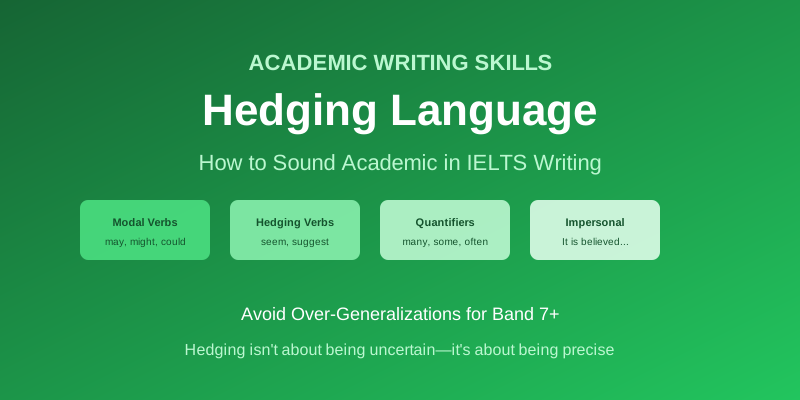
Hedging Language: How to Sound Academic in IELTS Writing
Over-generalization is one of the biggest obstacles to achieving Band 7+ in Task Response. The official band descriptors explicitly state that Band 7 essays may have "a tendency to over-generalize"—meaning essays that over-generalize don't fully meet Band 7 requirements.
Hedging language is the solution. It's the academic writer's tool for making claims precise, accurate, and defensible.
This guide shows you what hedging is, why IELTS examiners value it, and exactly how to use it in your essays.
What Is Hedging?
Hedging means using language that softens or qualifies your claims. Instead of stating something as absolute fact, you acknowledge uncertainty, limits, or alternative possibilities.
Without hedging (over-generalization):
Social media causes depression in teenagers.
With hedging (precise claim):
Social media may contribute to depression in some teenagers.
The hedged version is more accurate. Not ALL social media causes depression. Not ALL teenagers are affected. The relationship might be contribution, not direct causation.
Why Hedging Matters for Your Score
Task Response
The Band 7+ descriptors expect you to avoid over-generalization. Hedging shows you understand the complexity of issues rather than making sweeping claims.
Lexical Resource
Hedging language demonstrates vocabulary range. Modal verbs, qualifying adverbs, and cautious phrases show sophistication.
Critical Thinking
Hedging signals that you've considered your claims carefully. Examiners recognize this as a sign of academic maturity.
Types of Hedging Language
1. Modal Verbs
Modal verbs express degrees of certainty or possibility.
Strong certainty:
- will, must
- "Technology will continue to advance."
Medium certainty:
- should, would, ought to
- "Governments should consider this approach."
Low certainty:
- may, might, could, can
- "This may lead to problems."
- "Technology could have negative effects."
Examples in context:
- "Technology makes people less sociable." → "Technology may make some people less sociable."
- "This policy will solve the problem." → "This policy could help address the problem."
2. Hedging Verbs
Certain verbs inherently express uncertainty or interpretation.
Common hedging verbs:
- seem, appear, tend
- suggest, indicate, imply
- believe, think, consider
Examples:
- "Research suggests a correlation between X and Y."
- "The data appears to indicate a decline."
- "People tend to underestimate this factor."
- "It seems that governments are reluctant to act."
3. Qualifying Adverbs
Adverbs that modify the strength of claims.
Frequency adverbs:
- often, frequently, sometimes, occasionally, rarely
- "Students often struggle with this aspect."
Probability adverbs:
- probably, possibly, perhaps, likely
- "This is probably the main cause."
- "Perhaps more research is needed."
Degree adverbs:
- somewhat, relatively, fairly, rather
- "The effects are somewhat unpredictable."
- "This is relatively common in urban areas."
4. Quantifying Language
Instead of "all" or "none," use more precise quantities.
Replace absolute terms:
- all → most, many, the majority of
- none → few, hardly any, very few
- always → usually, generally, typically
- never → rarely, seldom, hardly ever
Examples:
- "Everyone agrees that..." → "Most people agree that..."
- "Teenagers always prefer..." → "Teenagers generally prefer..."
- "This never works." → "This rarely works."
5. Impersonal Constructions
Removing personal certainty from claims.
Useful phrases:
- It is believed that...
- It has been suggested that...
- It could be argued that...
- There is evidence to suggest...
- Some researchers claim that...
Examples:
- "It is widely believed that technology improves education."
- "There is growing evidence to suggest a connection."
- "Some experts argue that this approach is ineffective."
6. Concessive Language
Acknowledging alternative views or limitations.
Useful phrases:
- although, while, despite
- to some extent, in some cases
- in certain circumstances
Examples:
- "While this may be true in some cases, the overall trend suggests otherwise."
- "To some extent, this argument has merit."
- "This approach works well in certain circumstances."
Before and After Examples
Example 1: Cause and Effect
Over-generalized:
Watching television makes children violent.
Hedged:
Exposure to violent television content may contribute to aggressive behavior in some children, although other factors also play a role.
Example 2: Predictions
Over-generalized:
Renewable energy will replace fossil fuels completely.
Hedged:
Renewable energy is likely to play an increasingly significant role and could potentially replace much of our dependence on fossil fuels in the coming decades.
Example 3: Social Claims
Over-generalized:
Old people can't use technology.
Hedged:
Many older adults tend to find modern technology challenging, though this varies considerably depending on exposure and education.
Example 4: Opinion Statement
Over-generalized:
Social media destroys relationships.
Hedged:
There is some evidence to suggest that excessive social media use may negatively impact interpersonal relationships in certain circumstances.
How Much Hedging Is Enough?
Don't Over-Hedge
Too much hedging makes your writing weak and unclear.
Over-hedged (too weak):
It might possibly be the case that there could perhaps be some evidence that may suggest technology might have certain effects that could potentially be considered somewhat negative in some circumstances.
This is unreadable and shows no confidence in your position.
Find the Balance
Hedge when:
- Making claims about cause and effect
- Discussing trends or predictions
- Referring to groups of people
- Stating opinions as if they were facts
Don't hedge when:
- Stating your opinion clearly (you can be confident about YOUR view)
- Referring to established facts
- Describing what the question says
Balanced example:
In my view, excessive technology use is harmful. Research suggests that young people who spend more than four hours daily on screens are more likely to experience attention problems. While some technology use is unavoidable, it appears that moderation is essential for healthy development.
Notice: "In my view" is confident (your opinion), but the evidence-based claims are hedged.
Practice Exercise
Rewrite these over-generalized sentences using hedging:
Original: Money makes people happy.
Hedged: ____Original: City life is stressful.
Hedged: ____Original: Social media has ruined communication.
Hedged: ____
Suggested answers:
Money may contribute to happiness up to a certain point, although research suggests that beyond basic needs, additional wealth has diminishing effects on wellbeing.
City life can be stressful for many people, particularly due to factors such as noise, crowds, and fast-paced work environments.
Some argue that social media has negatively affected certain aspects of communication, though others contend it has simply changed how people interact.
Key Hedging Phrases for IELTS
For introducing ideas:
- It could be argued that...
- There is evidence to suggest...
- Research indicates that...
- It appears that...
For quantifying:
- In many cases...
- To a large/certain extent...
- For the most part...
- In general...
For showing possibility:
- This may/might/could...
- It is possible that...
- There is a possibility that...
- This is likely to...
For acknowledging limits:
- Although this may be true...
- While there are exceptions...
- Despite some evidence to the contrary...
- In certain circumstances...
Key Takeaways
- Hedging prevents over-generalization—a Band 7+ requirement
- Use modal verbs (may, might, could) for uncertainty
- Quantify claims (many, some, often) instead of absolutes
- Include hedging verbs (seems, appears, suggests)
- Balance is essential—don't over-hedge into vagueness
- Stay confident about your opinion—hedge the evidence, not your position
Hedging isn't about being uncertain. It's about being precise.
Want feedback on whether your essays over-generalize? BandWriteCoach identifies sweeping claims and helps you develop more nuanced, Band 7+ language.