
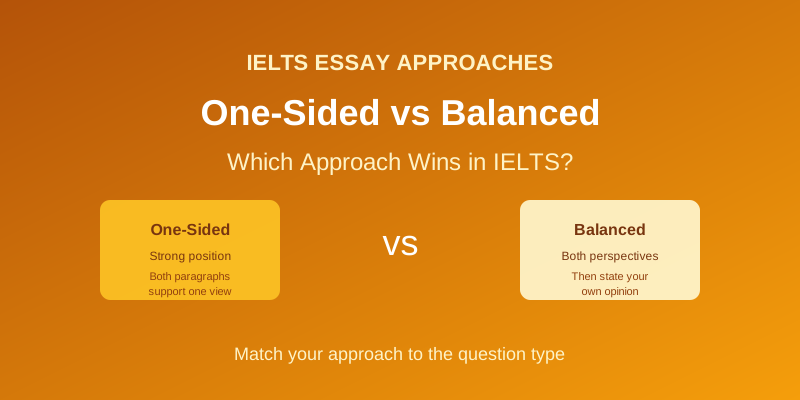
One-Sided vs Balanced Essays: Which Approach Wins in IELTS?
One of the most confusing aspects of IELTS Writing is whether you should argue strongly for one side or present a balanced view of both perspectives.
Some teachers say: "Pick a side and defend it strongly!"
Others say: "Show you can see both perspectives!"
Both can work—but only if you match your approach to the question type. This guide clarifies when to use each approach and how to structure them effectively.
The Three Main Approaches
Approach 1: One-Sided (Strong Agree/Disagree)
You argue entirely for one position. Every body paragraph supports your view.
When to use:
- "To what extent do you agree or disagree?" (and you fully agree/disagree)
- "Do you agree or disagree?" (and you have a clear position)
- When you have strong reasons for one side
Structure:
- Introduction: State your position clearly
- Body 1: First reason supporting your position
- Body 2: Second reason supporting your position
- Conclusion: Reaffirm your position
Approach 2: Balanced (Both Sides)
You discuss both perspectives fairly before stating your opinion.
When to use:
- "Discuss both views and give your opinion"
- "What are the advantages and disadvantages?"
- When the question explicitly asks for multiple perspectives
Structure:
- Introduction: Present the debate + hint at your position
- Body 1: One perspective with reasoning
- Body 2: Opposite perspective with reasoning
- (Optional Body 3: Why you favor one side)
- Conclusion: Your overall view
Approach 3: Partial Agreement (Nuanced)
You agree/disagree to some extent, acknowledging complexity.
When to use:
- "To what extent do you agree or disagree?" (when you see merit in both sides)
- When the issue is genuinely complex
- When you can articulate specific conditions
Structure:
- Introduction: State your nuanced position
- Body 1: The extent to which you agree (or the valid aspects)
- Body 2: The extent to which you disagree (or the limitations)
- Conclusion: Summary of your balanced view
Matching Approach to Question Type
"Discuss both views and give your opinion"
Required approach: Balanced
This question explicitly asks you to discuss BOTH views. You must give fair treatment to both perspectives, then state your own opinion.
Mistake to avoid: Spending 80% of your essay on one view and barely mentioning the other.
Example structure:
Introduction: Some people believe governments should invest heavily in space exploration, while others argue this money should address problems on Earth. This essay will discuss both perspectives and explain why I believe a balanced approach is most sensible.
Body 1 (View 1): Supporters of space exploration argue that...
Body 2 (View 2): On the other hand, critics suggest that...
Conclusion: In my opinion, while both views have merit, governments should prioritize Earth-based problems while maintaining modest space programs.
"To what extent do you agree or disagree?"
Required approach: Any—but match your answer to your structure
"To what extent" allows you to fully agree, fully disagree, or partially agree. But your structure must reflect your position:
If you fully agree/disagree:
Both body paragraphs should support your position.
If you partially agree:
One body paragraph should explain what you agree with, another should explain your reservations.
Mistake to avoid: Saying "I completely agree" in the introduction, then spending a body paragraph discussing the opposite view without clearly framing it as a counterargument you're rejecting.
"Do you agree or disagree?"
Best approach: One-sided or partial
This question asks for YOUR opinion. You can argue one side strongly, or you can present a nuanced view. You don't need to discuss "both sides" unless you choose to.
One-sided example:
I strongly disagree with this statement for two main reasons. Firstly... Secondly...
Partial agreement example:
While I agree that technology has some negative effects, I believe its benefits outweigh its drawbacks. The negative effects include... However, the benefits are more significant because...
"What are the advantages and disadvantages?"
Required approach: Balanced
This question explicitly asks for both sides. You must discuss both advantages AND disadvantages.
Structure:
Body 1: Advantages (at least 2)
Body 2: Disadvantages (at least 2)
Conclusion: Your view on whether advantages outweigh disadvantages (optional but recommended)
Common Mistakes
Mistake 1: Mismatched Position and Structure
Problem: Your introduction says one thing, but your body paragraphs do something else.
Introduction: "I completely agree with this statement."
Body 1: Arguments for
Body 2: Arguments against (with no framing)
This confuses examiners. If you "completely agree," why are you presenting counterarguments as if they're valid?
Solution: If you want to address counterarguments, frame them explicitly:
"Some might argue that... However, this view fails to consider..."
Mistake 2: No Clear Position in Balanced Essays
Problem: Discussing both sides without ever stating your own view.
This costs you marks for Task Response. "Discuss both views AND give your opinion" means you must give your opinion.
Solution: Always state your position in the conclusion (and ideally hint at it in the introduction).
Mistake 3: Weak Position in One-Sided Essays
Problem: Saying "I agree" but only giving weak, undeveloped reasons.
Solution: If you choose a one-sided approach, commit to it. Develop your reasons fully with examples and explanations.
Mistake 4: Sitting on the Fence
Problem: Concluding with "Both sides have valid points" without any real position.
This is evasive. Examiners want to see you take a position, even if that position is nuanced.
Solution: Even balanced essays should end with a clear statement:
"On balance, I believe the advantages outweigh the disadvantages."
"While both views have merit, I am more persuaded by the argument that..."
One-Sided Essay Example
Question: Some people think that governments should spend money on exploring outer space. Others believe this money should be used to address problems on Earth. Do you agree or disagree that space exploration is a waste of money?
One-sided response (disagrees that it's a waste):
Although Earth faces numerous challenges, I strongly disagree that space exploration represents a waste of financial resources. Investment in space programs generates significant benefits that justify the expenditure.
The primary value of space exploration lies in its technological spin-offs that directly improve life on Earth. GPS navigation, memory foam, water filtration systems, and medical imaging technology all originated from space research. These innovations have transformed daily life, healthcare, and global communication. The economic value of these technologies far exceeds the original investment in space programs.
Furthermore, space exploration addresses long-term survival concerns for humanity. Earth faces existential threats including asteroid impacts, climate change, and resource depletion. Developing the capability to establish human settlements beyond Earth provides a safeguard against planetary catastrophe. While these scenarios may seem distant, responsible planning requires preparing for them.
In conclusion, space exploration is far from a waste of money. Its technological benefits and role in securing humanity's future make it a valuable investment despite the pressing problems we face on Earth.
Analysis:
- Clear one-sided position stated immediately
- Both body paragraphs support the same position
- No weak "on the other hand" paragraph
- Conclusion reinforces the position
Balanced Essay Example
Question: Some people believe that universities should only offer subjects that prepare students for employment. Others think universities should offer any subject students want to study. Discuss both views and give your opinion.
Balanced response:
Universities have traditionally offered diverse subjects, but some now argue that higher education should focus exclusively on employability. This essay will examine both perspectives before explaining why I believe a middle ground is preferable.
Those who advocate for employment-focused education make practical arguments. With rising tuition costs, students and families expect a return on their investment through well-paid careers. Subjects like engineering, medicine, and business offer clearer pathways to employment than philosophy or art history. In economies facing skills shortages, universities arguably have a responsibility to produce graduates that meet market demands.
However, defenders of broad education contend that universities serve purposes beyond career preparation. Critical thinking, cultural knowledge, and intellectual curiosity—developed through humanities and social sciences—create well-rounded citizens capable of addressing complex social challenges. Moreover, employment patterns change rapidly; narrow vocational training may become obsolete, while transferable skills from diverse subjects remain valuable throughout careers.
In my view, universities should maintain diverse offerings while ensuring students understand employment implications of their choices. Completely eliminating non-vocational subjects would impoverish society intellectually, but students deserve honest guidance about career prospects. A balance between choice and practical information serves students best.
Analysis:
- Introduction acknowledges both sides and hints at balanced position
- Body 1 presents one view fairly
- Body 2 presents the opposing view fairly
- Conclusion states a clear personal position (middle ground)
Partial Agreement Example
Question: Some people argue that technology has made our lives easier. To what extent do you agree or disagree?
Partial agreement response:
Technology has undoubtedly transformed modern life, though whether it has made life easier is more complex than a simple yes or no. I partially agree with this statement, as technology has simplified many tasks while simultaneously introducing new complications.
In numerous ways, technology has genuinely reduced daily burdens. Communication that once required days or weeks now happens instantaneously. Household appliances have freed hours previously spent on manual labor. Access to information that once demanded library visits is now available within seconds. These conveniences represent real improvements to quality of life that previous generations could not imagine.
However, technology has also created new challenges that complicate modern existence. The expectation of constant availability through smartphones generates stress unknown to earlier generations. Information overload makes decision-making more difficult, not easier. Digital systems introduce dependencies—when they fail, our lives become temporarily paralyzed in ways that would not occur without them.
In conclusion, I believe technology has made some aspects of life easier while complicating others. The net effect depends largely on how individuals manage their relationship with technology—those who use it deliberately benefit more than those who allow it to dominate their attention.
Analysis:
- Introduction clearly states partial agreement
- Body 1 explains the extent of agreement
- Body 2 explains the limitations/disagreement
- Conclusion summarizes the nuanced position
Decision Framework
Step 1: Identify the question type
- "Discuss both views" → Balanced required
- "Advantages and disadvantages" → Balanced required
- "To what extent" → Your choice
- "Do you agree/disagree" → Your choice
Step 2: Decide your actual position
- Do you have a clear one-sided view?
- Do you see validity in both sides?
- Do you have conditions or qualifications?
Step 3: Match structure to position
- Clear position → One-sided structure
- See both sides → Balanced or partial
- Question requires both → Balanced
Key Takeaways
- Match your approach to the question—some questions require balanced treatment
- Any approach can work for "agree/disagree"—but structure must match your position
- Always state your opinion—even in balanced essays
- Commit to your position—avoid fence-sitting conclusions
- Be consistent—introduction and conclusion should align
The "best" approach is the one that matches both the question and your actual view. Examiners want to see clear thinking and consistent argumentation, not a formulaic approach applied to every question.
Not sure which approach your essay uses? BandWriteCoach analyzes your essay structure and tells you if your approach matches your question type.