
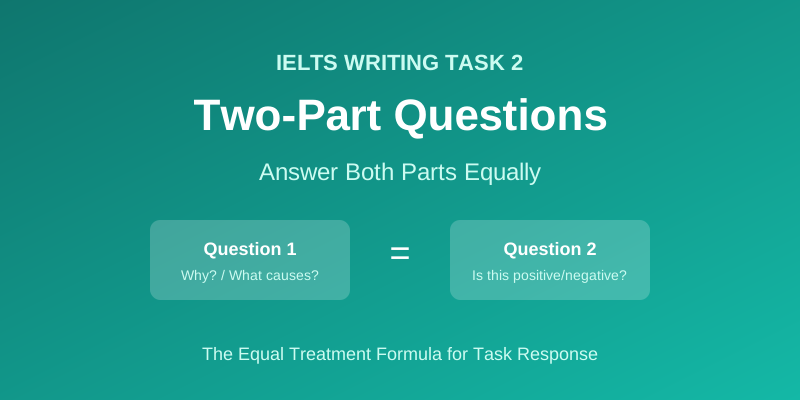
Two-Part Questions: How to Answer Both Parts Equally in IELTS Writing
Two-part questions (also called "double questions" or "direct questions") are among the most straightforward IELTS Writing Task 2 question types—yet many students lose marks by failing to address both parts adequately.
Unlike opinion or discussion essays where the question asks you to explore a topic generally, two-part questions give you two specific questions to answer. Your score depends heavily on answering BOTH questions fully and equally.
This guide shows you exactly how to structure your response, allocate your paragraphs, and avoid the common mistakes that limit scores.
What Is a Two-Part Question?
A two-part question presents a topic and then asks two distinct questions about it. The questions require separate, complete answers.
Example Question
More and more adults are choosing to play computer games.
Why is this happening? Is this a positive or negative development?
This question has:
- Question 1: Why are adults playing computer games? (causes)
- Question 2: Is this good or bad? (evaluation/opinion)
How to Identify Two-Part Questions
Look for:
- Two question marks
- Two distinct prompts separated by different question words (Why...? What...? Is this...?)
- Questions that require different types of answers (causes vs. solutions, reasons vs. opinions)
Common Two-Part Question Types
| First Question | Second Question |
|---|---|
| Why is this happening? | Is this positive or negative? |
| What are the causes? | What solutions exist? |
| What are the problems? | What can be done? |
| Why do people do this? | Should governments intervene? |
The Critical Rule: Equal Treatment
The most common mistake in two-part questions is answering one question fully while giving the other question only a brief response.
This directly affects your Task Response score.
The band descriptors specify that you must "address all parts of the task." If you write three paragraphs about causes and one sentence about whether it's positive or negative, you haven't addressed all parts equally.
The Equal Treatment Formula
If you write 250-280 words:
- Introduction: ~40-50 words (address both questions briefly)
- Body paragraph 1 (Question 1): ~80-100 words
- Body paragraph 2 (Question 2): ~80-100 words
- Conclusion: ~30-40 words (summarize both answers)
Both body paragraphs should be similar in length and depth.
The 4-Paragraph Structure
Two-part questions work best with a clear 4-paragraph structure:
Paragraph 1: Introduction (40-50 words)
- Paraphrase the statement/context
- Briefly outline your answers to both questions
Example:
Computer gaming among adults has increased significantly in recent years. This essay will argue that this trend is primarily driven by technological improvements and marketing strategies, and will explain why it should be viewed as a largely negative development.
Notice: The introduction mentions BOTH questions—the causes AND the evaluation.
Paragraph 2: First Question (80-100 words)
Answer the first question completely with:
- Topic sentence introducing your main point(s)
- Explanation/reasoning
- Example if appropriate
- Clear answer to the question
Example (answering "Why is this happening?"):
The primary reason adults are increasingly drawn to computer games is the sophistication of modern games. Unlike the simple games of previous decades, today's games offer complex narratives, stunning graphics, and opportunities for social interaction that appeal to mature audiences. Additionally, aggressive marketing strategies specifically target adult demographics, normalizing gaming as an acceptable leisure activity for all ages rather than just children.
Paragraph 3: Second Question (80-100 words)
Answer the second question completely with the same structure:
- Topic sentence
- Explanation/reasoning
- Example if appropriate
- Clear answer
Example (answering "Is this positive or negative?"):
Overall, this trend represents a negative development for society. Adults who spend excessive hours gaming often neglect important responsibilities such as work, family relationships, and physical health. Research has linked prolonged gaming to sedentary lifestyles and associated health problems. While some argue that gaming provides stress relief and social connection, these benefits are outweighed by the potential for addiction and the displacement of more productive activities.
Paragraph 4: Conclusion (30-40 words)
Summarize your answers to both questions without introducing new ideas.
Example:
In conclusion, technological advancement and marketing have driven adult gaming, but this trend should be viewed negatively due to its impact on health and productivity.
Complete Model Essay
Question: People prefer to watch foreign films rather than locally produced films. Why could this be? Should governments give more financial support to local film industries?
Introduction:
In many countries, audiences increasingly favor international films over domestic productions. This essay will examine the reasons behind this preference and argue that governments should indeed provide greater support to local filmmakers.
Body Paragraph 1 (Why?):
The preference for foreign films stems primarily from production quality and marketing reach. Hollywood and other major film industries benefit from significantly larger budgets, allowing for superior special effects, famous actors, and polished production values that local industries cannot match. Furthermore, international films receive massive marketing campaigns that create anticipation and awareness, while local films often struggle to reach their own domestic audiences due to limited advertising budgets. The globalization of streaming platforms has also made foreign content more accessible than ever before.
Body Paragraph 2 (Should governments support?):
Governments should provide financial support to local film industries for cultural and economic reasons. Domestically produced films preserve local languages, traditions, and stories that might otherwise be lost to cultural homogenization. They also create employment for local actors, directors, and technicians, contributing to the creative economy. Countries like France and South Korea have demonstrated that strategic government support can help local industries compete successfully with Hollywood. Without such intervention, smaller nations risk losing their unique cultural voices entirely.
Conclusion:
In summary, foreign films attract audiences through superior resources and marketing, and governments should support local industries to protect cultural heritage and maintain creative economies.
Word count: 258 words
Common Mistakes and How to Avoid Them
Mistake 1: Unequal Treatment
Problem: Writing extensively about one question while barely addressing the other.
Example of imbalanced essay:
- Body paragraph 1: 150 words on causes
- Body paragraph 2: 40 words on evaluation
Solution: Plan your essay to allocate similar word counts to each question. Use your planning time to ensure both answers are equally developed.
Mistake 2: Mixing Questions Together
Problem: Addressing both questions in both body paragraphs, creating confusion about which question you're answering.
Solution: Keep questions separated:
- Body paragraph 1 = First question ONLY
- Body paragraph 2 = Second question ONLY
Use clear topic sentences that signal which question you're addressing.
Mistake 3: Forgetting to State Your Position
Problem: For evaluation questions (Is this positive or negative? Should governments...?), describing both sides without clearly stating your position.
Solution: Always state your position clearly:
- "Overall, this is a negative development because..."
- "Governments should provide support for several reasons..."
- "In my view, the advantages outweigh the disadvantages..."
Mistake 4: Not Answering in the Introduction
Problem: Writing a vague introduction that doesn't preview your answers.
Solution: Your introduction should outline what your essay will argue for BOTH questions. The examiner should know your main answers before reading the body paragraphs.
Mistake 5: Adding New Ideas in the Conclusion
Problem: Introducing new arguments in the conclusion instead of summarizing.
Solution: Your conclusion should only restate your answers in different words. No new examples, no new reasoning—just a summary of what you've already said.
Planning Your Two-Part Essay
Use your 5 minutes of planning time effectively:
Step 1: Identify the Two Questions
Underline each question separately. Be clear about what each one asks.
Step 2: Generate Ideas for Each Question
Write 2-3 bullet points for each question:
Question 1 (Why?):
- Reason 1
- Reason 2
Question 2 (Positive/Negative?):
- My position: [positive/negative]
- Reason 1
- Reason 2
Step 3: Check for Balance
Are your ideas for both questions similarly developed? If not, add more to the weaker side.
Step 4: Draft Your Outline Statement
Write one sentence that previews both answers.
Two-Part Questions vs. Other Essay Types
| Essay Type | Structure | Key Difference |
|---|---|---|
| Two-Part Question | Answer question 1, then question 2 | Two separate answers needed |
| Problem-Solution | Describe problem, then solutions | One question, two aspects |
| Opinion | Present your view throughout | One position, defended |
| Discussion | Present both sides | Multiple perspectives |
Don't confuse two-part questions with these other types. The defining feature of two-part questions is two distinct questions requiring separate answers.
Practice Questions
Try planning or writing responses to these two-part questions:
Many countries are experiencing problems with their environment. What are the causes of these problems? What measures can be taken to address them?
Some people think young people should follow the traditions of their society. Others believe young people should be free to behave as they wish. What are the reasons for these different views? Which do you agree with?
More and more people are working from home rather than in offices. Why is this? Do you think this is a positive or negative development?
In many cities, the use of private cars is increasing. What problems does this cause? What are the solutions?
Key Takeaways
- Identify both questions clearly—underline them separately
- Give equal treatment to both questions in terms of length and depth
- Use separate body paragraphs for each question
- Preview both answers in your introduction
- State your position clearly when asked for evaluation
- Summarize both answers in your conclusion
- Plan carefully to ensure balanced development
Two-part questions test your ability to manage multiple tasks within a single essay. Master this structure, and you'll consistently score well on Task Response.
Need feedback on your two-part question essays? BandWriteCoach analyzes whether you've addressed both questions equally and provides specific guidance for improving your Task Response score.