
IELTS Vocabulary: Quality Over Quantity (What Examiners Actually Want)
Reading time: 14 minutes
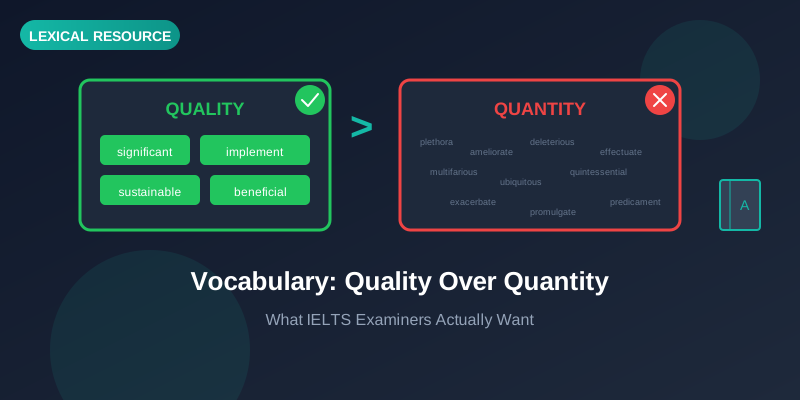
One of the most persistent myths in IELTS preparation is that higher vocabulary equals higher scores. Students memorize endless word lists, stuff essays with "sophisticated" synonyms, and believe that using uncommon words will impress examiners.
The reality is almost the opposite. Inappropriate vocabulary—even if technically "advanced"—damages rather than helps your score. What examiners actually reward is precision, appropriacy, and natural usage. Here's what that means in practice.
What the Band Descriptors Actually Say
Let's look at what IELTS examiners are told to evaluate for Lexical Resource:
Band 5:
- Limited range of vocabulary
- Noticeable errors in word choice and formation
- Frequent inappropriate word choices
Band 6:
- Adequate range of vocabulary for the task
- Some errors in word choice and formation, but meaning is generally clear
Band 7:
- Sufficient range to allow flexibility and precision
- Uses less common vocabulary with some awareness of style and collocation
- Occasional errors in word choice, spelling, and word formation
Band 8:
- Wide range of vocabulary used fluently and flexibly
- Skillful use of uncommon vocabulary with rare errors in word choice
- Produces rare errors only in spelling and word formation
Notice what's emphasized: range, flexibility, precision, appropriacy, and collocation awareness—not obscurity or complexity for its own sake. The descriptors mention "less common vocabulary" at Band 7, but paired with "awareness of style and collocation." Using rare words incorrectly is worse than using common words accurately.
The Real Problem: Sophisticated Vocabulary Used Wrong
Here's a common Band 5-6 pattern. A student learns that "plethora" is fancier than "many" and writes:
"There are a plethora of reasons why education is important."
Problems with this:
- "Plethora" traditionally implies excessive or unwanted abundance—it has negative connotations
- The grammar is questionable (plethora is singular, so "is" might be preferred)
- It sounds unnatural and forced
Compare with:
"There are numerous reasons why education is important."
This is simpler but perfectly appropriate, natural, and correct. It would score higher because it demonstrates accurate vocabulary use rather than inappropriate complexity.
What "Less Common Vocabulary" Actually Means
The Band 7 descriptor mentions "less common vocabulary," which students misinterpret as "rare, obscure words." In reality, it means:
Topic-specific vocabulary: Using "sustainable development" in an environmental essay, "curriculum reform" in an education essay, or "consumer behavior" in a marketing essay. These words are common within their topics but show you can discuss subjects with precision.
Precise alternatives to basic words: Instead of "good for the environment," writing "environmentally beneficial." Instead of "a lot of problems," writing "significant challenges." Not exotic words—just more precise ones.
Natural collocations: Words that naturally go together in English. "Heavy rain" not "strong rain." "Make progress" not "do progress." "Raise concerns" not "lift concerns."
Academic register: Using "consequently" instead of "so," "significant" instead of "big," "implement" instead of "do." These aren't rare words—they're common in formal writing.
Examples: Appropriate vs. Inappropriate Vocabulary
Basic (Band 5):
"Pollution is very bad for people's health."
Inappropriately "sophisticated" (still Band 5-6):
"Pollution is exceedingly deleterious for people's health."
Actually good (Band 7):
"Pollution poses significant health risks to urban populations."
The third version isn't using rare words—"significant," "health risks," and "urban populations" are all common. But they're precise, appropriate, and naturally collocated.
Basic:
"The government should do something about this problem."
Inappropriately complex:
"The government should effectuate ameliorative measures regarding this predicament."
Actually good:
"The government should implement targeted policies to address this issue."
Again, "implement," "targeted policies," and "address this issue" are all common in formal writing. They're appropriate, not exotic.
The Collocation Trap
Collocations—words that naturally pair together—are where vocabulary attempts often fail. English has "strong coffee" but "powerful engine," "make a decision" but "take action." These patterns must be learned through exposure, not memorized from lists.
Common collocation errors:
- "Do a crime" → commit a crime
- "Big/large advantage" → significant/major advantage
- "Fast increase" → rapid increase
- "Make effort" → make an effort
- "Give impact" → have an impact
- "Discuss about" → discuss (no preposition)
When students use unnatural collocations, even if the individual words are "advanced," the writing sounds awkward and loses marks.
The fix: Rather than learning words in isolation, learn them in phrases and sentences. When you encounter a new word in reading, note how it's used—what words come before and after it.
Register Mistakes
Register refers to the level of formality. IELTS Writing Task 2 requires academic register—formal, objective, professional. Many vocabulary errors are actually register errors.
Too informal:
"A lot of kids these days don't know stuff about their country's history."
Appropriate:
"Many young people today lack knowledge of their national history."
Both sentences use common words, but the second uses appropriate academic register: "many" instead of "a lot of," "young people" instead of "kids," "lack knowledge of" instead of "don't know stuff about."
Overly casual phrases to avoid:
- "a lot of" → many, numerous, significant numbers of
- "kids" → children, young people
- "stuff, things" → aspects, factors, elements
- "get" → obtain, receive, become
- "really big" → substantial, considerable, significant
How Examiners Actually Assess Vocabulary
Examiners look for evidence that you can:
- Use a range of vocabulary - Not just basic words, but varied word choice throughout
- Use vocabulary accurately - Words mean what you intend them to mean
- Use natural collocations - Words pair together in ways native speakers recognize
- Maintain appropriate register - Formal, academic language throughout
- Use topic-specific vocabulary - Relevant terms for the subject being discussed
A student who uses 10 words accurately scores higher than one who attempts 20 "sophisticated" words but uses half of them incorrectly.
The Vocabulary Strategy That Actually Works
1. Build Topic-Based Vocabulary
Instead of random word lists, build vocabulary around common IELTS topics:
Environment:
sustainable, renewable, emissions, conservation, biodiversity, carbon footprint, ecosystem, degradation, deforestation, pollution
Education:
curriculum, pedagogy, academic, vocational, literacy, cognitive development, critical thinking, assessment, educational attainment, lifelong learning
Technology:
innovation, digital, automation, artificial intelligence, connectivity, cybersecurity, digital divide, technological advancement, obsolete, digital literacy
These words appear frequently in IELTS essays and are naturally associated with their topics.
2. Learn Words in Context
Never learn a word alone. Learn it in a sentence, noting:
- What words come before and after it (collocations)
- Whether it's formal or informal (register)
- Whether it has positive or negative connotations
Example: Don't just learn "mitigate."
Learn: "Governments can mitigate the effects of climate change through targeted policies."
Now you know:
- "Mitigate" collocates with "effects"
- It's used in formal contexts
- It means reduce/lessen the severity of something negative
3. Practice Paraphrasing
Paraphrasing—expressing the same idea in different words—develops vocabulary flexibility naturally.
Original: "Technology has changed how people communicate."
Paraphrase 1: "Digital innovation has transformed interpersonal communication."
Paraphrase 2: "Advances in technology have revolutionized the way individuals interact."
This practice builds your ability to use varied vocabulary appropriately.
4. Read Academic English Regularly
The best vocabulary comes from exposure, not memorization. Read:
- News articles (BBC, The Guardian, The Economist)
- Academic blogs and opinion pieces
- IELTS model essays and examiner reports
When you encounter useful vocabulary in context, you absorb not just the word but how to use it naturally.
5. Create a Personal Vocabulary Notebook
Record useful vocabulary in a notebook organized by topic. For each word, include:
- Definition
- Example sentence (from where you found it)
- Collocations
- Your own example sentence
Review regularly and use new words in your practice essays.
Common Vocabulary Mistakes by Band Level
Band 5 errors:
- Repeating basic words ("good," "bad," "important") throughout
- Wrong word forms ("success" vs "successful" vs "successfully")
- Basic spelling errors
- Inappropriate informal language
Band 6 errors:
- Trying to use advanced vocabulary incorrectly
- Unnatural collocations
- Inconsistent register (mixing formal and informal)
- Limited topic-specific vocabulary
Band 7 errors (occasional only):
- Minor spelling or word form errors
- Slightly unnatural collocation choices
- Occasional imprecise word choice
The path from Band 5 to 6 is mainly about accuracy and appropriacy. The path from Band 6 to 7 adds flexibility and precision.
The Bottom Line
Stop trying to impress examiners with rare words. Instead:
- Use vocabulary accurately - Better to be simple and correct than complex and wrong
- Use natural collocations - Words that pair together as native speakers use them
- Maintain academic register - Formal, professional language throughout
- Build topic-specific vocabulary - Learn relevant words for common IELTS themes
- Develop through exposure - Reading teaches vocabulary better than memorizing
Remember: Band 7 doesn't require obscure vocabulary. It requires "sufficient range to allow flexibility and precision" with "some awareness of style and collocation." That's achieved through accurate, appropriate, varied vocabulary—not dictionary rarities.
The students who score highest in Lexical Resource aren't those with the biggest vocabulary. They're those who use the right word in the right place, every time.
Want to know if your vocabulary is helping or hurting your score? We're currently in closed beta—join the waitlist to get early access to detailed lexical resource feedback.