
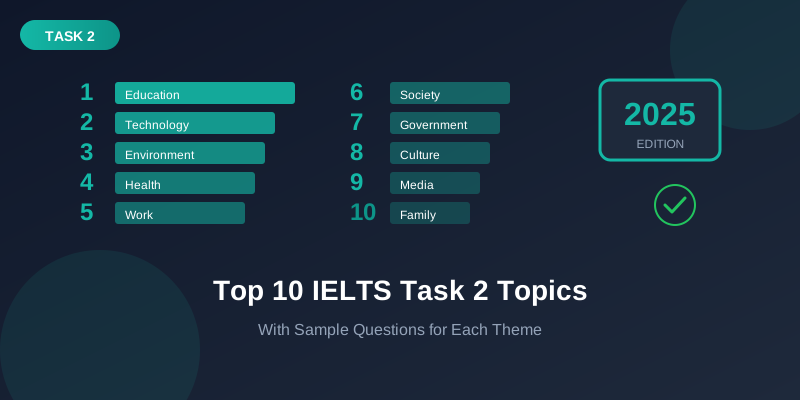
The Top 10 IELTS Task 2 Topics in 2025 (With Sample Questions)
Reading time: 15 minutes
While you can't predict exactly which question will appear on your IELTS test, certain themes appear consistently year after year. Understanding these common topics and practicing with relevant questions gives you a significant advantage: you'll develop ideas and vocabulary in advance rather than facing unfamiliar territory on test day.
Based on analysis of actual IELTS questions from recent exams, here are the 10 most frequently tested topics—with sample questions for each.
1. Education
Education consistently ranks as the most common IELTS topic. Questions cover everything from teaching methods to higher education access, children's development, and the role of technology in learning.
Sample Questions:
Opinion:
Some people believe that children should begin learning a foreign language at primary school rather than secondary school. To what extent do you agree or disagree?
Discussion:
Some people think that students should study subjects they enjoy, while others believe they should focus on subjects that will be useful for their future career. Discuss both views and give your opinion.
Problem-Solution:
Many young people today are choosing not to go to university and are entering the workforce directly after school. What problems does this cause? What solutions can you suggest?
Key vocabulary to prepare: curriculum, academic, vocational, tuition, pedagogy, literacy, critical thinking, student-centered, rote learning, extracurricular
2. Technology
Technology questions have increased significantly in recent years, with newer questions focusing on artificial intelligence, social media, automation, and digital transformation.
Sample Questions:
Advantages/Disadvantages:
Many people today use social media for their news rather than traditional newspapers or television. What are the advantages and disadvantages of this?
Opinion:
Some people think that artificial intelligence will replace many jobs in the future. Do you think this is a positive or negative development?
Discussion:
Some believe that technology has improved communication between people, while others argue it has made us more isolated. Discuss both views and give your opinion.
Key vocabulary to prepare: automation, digital literacy, cybersecurity, artificial intelligence, innovation, digital divide, screen time, virtual reality, remote work, data privacy
3. Environment
Environmental topics remain consistently popular, often overlapping with government policy and economic development themes.
Sample Questions:
Opinion:
Some people believe that the best way to reduce pollution is to increase taxes on fuel for cars and other vehicles. To what extent do you agree or disagree?
Discussion:
Some believe that environmental protection should be the responsibility of governments, while others think individuals should take action. Discuss both views and give your opinion.
Cause/Effect:
Plastic waste is becoming an increasingly serious problem. What are the causes of this issue? What measures can be taken to solve it?
Key vocabulary to prepare: sustainability, carbon footprint, renewable energy, conservation, biodiversity, deforestation, emissions, climate change, ecosystem, pollution
4. Health
Health questions cover public health policies, lifestyle choices, healthcare systems, and individual versus government responsibility for wellness.
Sample Questions:
Opinion:
Many manufactured food and drink products contain high levels of sugar, which causes health problems. Sugary products should be made more expensive to encourage people to consume less sugar. Do you agree or disagree?
Discussion:
Some people think that governments should be responsible for public health, while others believe that individuals should take care of their own health. Discuss both views and give your opinion.
Problem-Solution:
In many countries, people are living longer and the number of elderly people is increasing. What problems does this cause? What solutions can you suggest?
Key vocabulary to prepare: obesity, sedentary lifestyle, healthcare system, mental health, preventive care, nutrition, exercise, work-life balance, life expectancy, well-being
5. Work and Employment
Questions about work address modern employment challenges, work-life balance, career development, and the changing nature of jobs.
Sample Questions:
Opinion:
Some people think that the best way to choose a career is to consider financial rewards, while others believe job satisfaction is more important. What is your opinion?
Discussion:
Some people believe that employees should remain loyal to one company throughout their career, while others think changing jobs regularly is beneficial. Discuss both views and give your opinion.
Advantages/Disadvantages:
More and more people are working from home rather than in offices. Do the advantages of this outweigh the disadvantages?
Key vocabulary to prepare: work-life balance, remote work, career progression, job satisfaction, employment, productivity, freelance, automation, workplace culture, retirement
6. Society and Social Issues
This broad category includes questions about crime, inequality, urbanization, family structures, and social change.
Sample Questions:
Opinion:
The gap between rich and poor continues to increase in many countries. To what extent do you think this is a problem, and what solutions can governments implement?
Discussion:
Some believe that criminal justice systems should focus on punishment, while others think rehabilitation is more important. Discuss both views and give your opinion.
Cause/Effect:
In many countries, people are leaving rural areas and moving to cities. Why is this happening? What are the consequences of this migration?
Key vocabulary to prepare: inequality, poverty, crime prevention, urbanization, social mobility, community, rehabilitation, social welfare, housing, integration
7. Government and Public Services
Questions about government focus on spending priorities, public services, regulations, and the balance between government control and individual freedom.
Sample Questions:
Discussion:
Some people think that governments should spend money on faster public transport, while others believe money should be spent on roads. Discuss both views and give your opinion.
Opinion:
Governments should not fund the arts (music, theatre, visual arts). They should spend their money on more important things. To what extent do you agree or disagree?
Advantages/Disadvantages:
In many countries, governments are increasingly using surveillance cameras in public places. What are the advantages and disadvantages of this?
Key vocabulary to prepare: public funding, infrastructure, taxation, policy, legislation, public services, regulation, accountability, transparency, civic responsibility
8. Globalization and Culture
These questions explore cultural exchange, international travel, preservation of traditions, and the effects of global connection.
Sample Questions:
Opinion:
Many people think that the best way to learn about a culture is to learn its language. To what extent do you agree or disagree?
Discussion:
Some believe globalization has a positive effect on local cultures, while others think it threatens cultural diversity. Discuss both views and give your opinion.
Advantages/Disadvantages:
International tourism is now more common than ever before. What are the advantages and disadvantages of this development?
Key vocabulary to prepare: cultural heritage, globalization, traditions, diversity, homogenization, cultural exchange, identity, multinational, immigration, integration
9. Media and Advertising
Questions address the influence of media, advertising ethics, and the role of information sources in society.
Sample Questions:
Opinion:
Some people think that advertising aimed at children should be banned. To what extent do you agree or disagree?
Discussion:
Some believe that news media should always be completely objective, while others think journalists should be able to express their opinions. Discuss both views and give your opinion.
Cause/Effect:
Many people now get their information from social media rather than traditional news sources. What are the effects of this change?
Key vocabulary to prepare: advertising, consumer, mass media, social media influence, fake news, journalism, censorship, freedom of press, entertainment, information overload
10. Children and Family
Questions explore parenting approaches, childhood development, family structures, and the balance between school and home education.
Sample Questions:
Discussion:
Some people think that parents should teach children how to be good members of society. Others believe that school is the place to learn this. Discuss both views and give your opinion.
Opinion:
Some people believe that children should be allowed to do what they like with their free time, while others think their activities should be organized by adults. What is your opinion?
Cause/Effect:
In many countries, young people are leaving home at an older age than in the past. Why is this happening? What are the effects on families and society?
Key vocabulary to prepare: parenting, childhood development, discipline, upbringing, independence, family structure, values, role models, supervision, socialization
How to Use This Topic List Effectively
1. Develop Ideas in Advance
For each topic, brainstorm 4-5 key arguments you could use. What are the main benefits of technology in education? What are the primary causes of environmental pollution? Having ready-made ideas saves precious thinking time during the exam.
2. Build Topic-Specific Vocabulary
Generic vocabulary like "good," "bad," and "important" won't impress examiners. For each topic, learn 10-15 precise terms that demonstrate sophisticated lexical resource. Use these words in practice essays until they become natural.
3. Practice Multiple Question Types
The same topic can appear as an opinion essay, discussion essay, problem-solution essay, or advantages/disadvantages essay. Practice approaching your prepared topics from different angles.
4. Connect Topics Together
Many IELTS questions combine topics. "Should governments tax unhealthy foods?" combines health and government. "Is technology harming children's development?" combines technology and children. Practice seeing connections between themes.
5. Read Widely on These Themes
The best vocabulary and ideas come from exposure, not memorization. Read news articles and opinion pieces on these topics in English. You'll naturally absorb language patterns and arguments you can adapt in your essays.
Topics That May Increase in 2025
Based on recent trends and global developments, watch for questions about:
- Artificial intelligence and automation: Impact on jobs, education, and daily life
- Climate change and individual action: Personal responsibility versus systemic change
- Remote work and flexible employment: Long-term effects of pandemic-era changes
- Mental health awareness: Increasing focus on psychological well-being
- Digital privacy and data security: Rights in the age of constant connectivity
- Sustainable consumption: Environmental impact of consumer choices
A Word of Caution
While preparing for common topics is smart strategy, avoid memorizing complete essays. Examiners are trained to detect memorized responses, and questions rarely match your prepared answer perfectly.
Instead, prepare flexible ideas and vocabulary that you can adapt to specific questions. Know the topic area well enough to respond to any angle the question might take.
The goal isn't to predict your exact question—it's to walk into the exam confident that whatever topic appears, you have the knowledge and vocabulary to respond effectively.
Ready to practice with these topics? We're currently in closed beta—join the waitlist to get early access to instant feedback on your essays.