
IELTS Opinion Essay: How to Structure a Band 7 Response
Reading time: 12 minutes
The opinion essay is the most common question type in IELTS Writing Task 2. Whether it asks "Do you agree or disagree?", "To what extent do you agree?", or simply "What is your opinion?", the approach is fundamentally the same—and getting the structure right is crucial for Band 7+.
Many students find opinion essays challenging because they're unsure how strongly to state their position, whether to acknowledge the opposing view, or how to develop their arguments sufficiently. This guide provides a clear, proven structure that works for any opinion question.
Understanding Opinion Essay Questions
Despite slight variations in wording, all opinion questions ask the same thing: What do you think, and why?
Here are common phrasings you'll encounter:
- "Do you agree or disagree?"
- "To what extent do you agree or disagree?"
- "What is your opinion?"
- "Do you think this is a positive or negative development?"
The instruction "To what extent" sometimes confuses students. They wonder if they must partially agree. The truth is simpler: you can completely agree, completely disagree, or partially agree—as long as your position is clear and well-supported. "To what extent" simply invites you to consider the strength of your opinion.
Critical point: Your position must remain consistent throughout. If you agree in your introduction, don't suddenly disagree in your conclusion. Inconsistency severely damages your Task Response score.
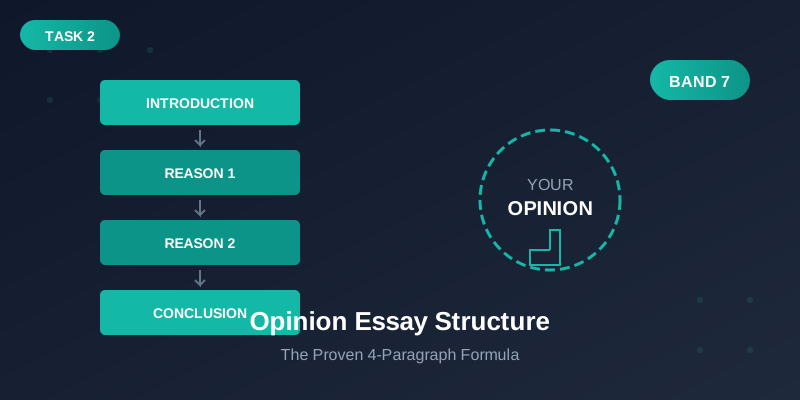
The Four-Paragraph Structure That Works
For opinion essays, this structure is approved by IELTS examiners and allows for clear, coherent arguments:
Paragraph 1: Introduction (2-3 sentences)
- Paraphrase the question
- State your position clearly
Paragraph 2: First reason for your position (5-6 sentences)
- Topic sentence presenting your first reason
- Explanation and development
- Specific example
- Link back to your position
Paragraph 3: Second reason for your position (5-6 sentences)
- Topic sentence presenting your second reason
- Explanation and development
- Specific example
- Link back to your position
Paragraph 4: Conclusion (2-3 sentences)
- Restate your position
- Summarize your main reasons
This structure ensures you fully develop two strong reasons rather than briefly mentioning five weak ones. Development of ideas is essential for Band 7—the descriptors specifically require "extended and well-supported ideas."
Breaking Down Each Paragraph
The Introduction
Your introduction has two jobs: show you understand the question and state your position. That's it. Don't over-complicate it.
Question: Some people believe that unpaid community service should be a compulsory part of high school programmes. To what extent do you agree or disagree?
Weak introduction:
"In today's modern world, there are many opinions about education and community service. Some people think community service should be compulsory while others disagree. In my opinion, this is a very important topic to discuss."
This wastes words without stating a clear position.
Strong introduction:
"The proposal to make community service mandatory for high school students has gained considerable attention in recent years. While some view this as an imposition on young people's time, I firmly believe that compulsory volunteering would provide invaluable life skills and strengthen community bonds."
Notice how the second version:
- Paraphrases the question (doesn't copy it word-for-word)
- Acknowledges the topic briefly
- States a clear position using "I firmly believe"
- Hints at the reasons that will follow
Body Paragraph 1
Your first body paragraph presents your strongest reason for your position. Start with a clear topic sentence, then develop the idea fully.
Structure:
- Topic sentence (your first reason)
- Explanation (why this matters)
- Example (specific evidence)
- Concluding link (connect back to your position)
Example:
"The primary benefit of mandatory community service is the development of practical skills that classroom learning cannot provide. When students volunteer at local organizations, they learn to work with diverse groups, manage their time effectively, and solve real-world problems under pressure. For instance, students helping at food banks quickly develop organizational abilities and interpersonal skills as they coordinate with staff and serve clients from various backgrounds. These competencies prove invaluable in both higher education and future careers, making the experience far more than a mere obligation."
This paragraph has:
- A clear topic sentence stating the main point (practical skills development)
- Explanation of why this matters
- A specific example (food bank volunteering)
- A link showing why this supports the original position
Body Paragraph 2
Your second paragraph presents an additional reason. Use the same structure but introduce a genuinely different point.
Example:
"Beyond individual development, compulsory volunteering strengthens the relationship between young people and their communities. Many teenagers today live in relative isolation, engaged primarily with their phones and social media rather than their neighbors. Community service programs force meaningful interaction across generations and social groups, fostering empathy and civic responsibility. A student tutoring younger children at a community center, for example, gains an understanding of educational challenges in their area while the children benefit from additional support. This reciprocal relationship builds community cohesion in ways that purely academic programs cannot achieve."
The Conclusion
Your conclusion should take no more than 2-3 sentences. Restate your position (using different words) and briefly summarize your main reasons.
Example:
"In conclusion, requiring community service in high schools offers substantial benefits for both students and society. The combination of practical skill development and stronger community connections makes such programs a valuable addition to any educational curriculum."
What to avoid in conclusions:
- Introducing new ideas
- Using "In a nutshell" or other memorized phrases
- Simply copying your introduction
- Long, rambling summaries
Should You Discuss Both Sides?
This is the most common question about opinion essays. The short answer: you don't have to, but you can if it strengthens your argument.
For a "Do you agree or disagree?" question, you can write entirely about your own view. However, briefly acknowledging the opposing perspective can demonstrate sophistication—as long as you then refute it or explain why your view is stronger.
Option 1: Two paragraphs supporting your view (simpler, perfectly acceptable)
Option 2: One paragraph opposing view + one paragraph your view (can work but risks weak development)
Option 3: Acknowledge opposing view within your paragraphs, then counter it (most sophisticated)
For example, in a body paragraph:
"Critics might argue that mandatory volunteering contradicts the very spirit of volunteerism. However, research consistently shows that even initially reluctant participants develop genuine appreciation for community work once engaged. The compulsory element overcomes inertia rather than undermining motivation."
This approach shows you've considered multiple perspectives while maintaining your clear position.
Common Mistakes That Kill Your Score
Mistake 1: Unclear or Changing Position
The problem: Saying "I partially agree" and then failing to explain what you agree with and what you disagree with. Or agreeing in the introduction and seeming to disagree by the conclusion.
The fix: Decide your position before you write. Stick to it throughout. If you partially agree, be explicit about which aspects you support and which you don't.
Mistake 2: Underdeveloped Ideas
The problem: Listing five reasons with one sentence each instead of fully developing two reasons.
The fix: Two well-developed paragraphs beat five superficial points every time. For each reason, ask yourself: Why is this true? What example proves this? How does this connect to my main argument?
Mistake 3: Generic or Irrelevant Examples
The problem: "For example, many studies show this is true" or examples that don't actually illustrate your point.
The fix: Create specific, plausible examples. You don't need to cite real research—examiners know you're writing under time pressure. A detailed hypothetical example works perfectly: "A student volunteering at an elderly care home, for instance, develops patience and communication skills while residents benefit from companionship."
Mistake 4: Template Language That Doesn't Fit
The problem: Using memorized phrases regardless of whether they suit the question.
The fix: Learn flexible structures, not rigid templates. Phrases like "It is widely believed that..." or "There is no doubt that..." should only appear when they genuinely fit your argument.
Mistake 5: Weak Conclusions
The problem: "In conclusion, there are advantages and disadvantages to this topic. The government should take action."
The fix: Your conclusion must reflect your specific position and reasons. If someone reads only your conclusion, they should understand exactly what you argued.
Sample Band 7 Opinion Essay
Question: Some people think that governments should spend money on faster public transport. Others believe that money should be spent on other priorities such as schools and hospitals. Discuss your view.
The allocation of government funding is a perpetual challenge, with both transport infrastructure and social services competing for limited resources. While education and healthcare undoubtedly deserve investment, I believe that faster public transport should also receive significant funding due to its broad societal benefits.
Efficient public transport systems directly impact economic productivity in ways that ultimately benefit all public services. When commuters spend less time traveling, they contribute more working hours to the economy, generating tax revenue that can fund schools and hospitals. Cities like Tokyo and Singapore demonstrate this principle effectively—their world-class transit systems enable workers to live affordably in suburbs while accessing employment centers quickly, boosting both individual earnings and national economic output. Viewed through this lens, transport investment is not a competing priority but rather an enabler of other government objectives.
Furthermore, improved public transport addresses pressing environmental and health concerns that would otherwise burden healthcare systems. Congested roads filled with idling vehicles create air pollution that causes respiratory diseases, heart conditions, and premature deaths—all requiring expensive medical treatment. By contrast, fast, reliable trains and buses encourage people to abandon their cars, reducing emissions and improving urban air quality. A city that invests in clean public transport today spends less on treating pollution-related illnesses tomorrow, freeing healthcare budgets for other needs.
In conclusion, while schools and hospitals are essential, viewing transport investment as their competitor reflects a false choice. Faster public transport generates economic returns and reduces healthcare burdens, ultimately supporting rather than undermining other government priorities.
Word count: 262
Why this works:
- Clear position stated in introduction
- Two distinct, well-developed reasons
- Specific examples (Tokyo, Singapore)
- Each paragraph links back to the main argument
- Conclusion reinforces position without introducing new ideas
- Sophisticated acknowledgment of the opposing view while maintaining focus
Key Takeaways
- Clear position: State your view explicitly in the introduction and maintain it throughout
- Development over breadth: Two well-developed reasons beat five brief points
- Specific examples: Create detailed, relevant examples that illustrate your arguments
- Consistent structure: Introduction → Reason 1 → Reason 2 → Conclusion
- Avoid templates: Learn flexible structures that adapt to any question
The opinion essay tests whether you can construct a logical argument and express it clearly. With the right structure and sufficient practice, Band 7 is within reach for any dedicated student.
Want to see how your opinion essays measure up? We're currently in closed beta—join the waitlist to get early access to instant feedback on your argument development.